
Qussa

Stories from Afar & Up Close

Filtering by Category: Typical---

Wedding Season: 2008 (extended edition)

Tomorrow is the finale of wedding season 2008: I will attend my fifth (and last) wedding of this summer. It will be the fifth time that I am supposed to get a new dress, new shoes, new purse, and a professional to do my hair and make-up for a considerable amount of money. (And to think that five is not even considered to be a lot, knowing that one of my friends had to attend no less than 14 weddings over the course of four months – that’s more than one a week!) (And to add that I am lucky that not all my friends know each other, so I can get away with alternating dresses and switching shoes to look all new and shiny for the next party…) (But I digress.) The season was actually kicked off in The Netherlands by my cousin who finally got married to his boyfriend. Hilarity all over, of course, when I came back to Beirut and was asked to recount my holiday-adventures in Arabic class. ‘So, I went to my cousins wedding, and his husband…’ ‘HER husband’, my teacher immediately corrected, ‘ehm, no, HIS husband….’ Oh yes, that’s how we do things in Holland, as she remarked rather displeased, but in Lebanon, weddings aren’t to be taken too lightly.

Weddings in Lebanon are serious business, in fact. Everything is important: the amount of invitees, the number of guests, the prestige of the location, the abundance of the decoration, the costumes of the dancers, the freshness of the flower-arrangements, the amount of food, the sparklingness of the bride’s dress – everything. For upper class Lebanese, weddings are the ultimate way to show their position in society, and for those longing to be part of the upper class they are the ultimate way to create a gigantic debt and pretend to have a position in society to show off. Upper class weddings are nothing like the village wedding that I attended two years ago, where all the guests fitted in one front yard.

A typical wedding will include all or most of the following: - 1/3rd of the more than 500 guests are friends and close relatives of the couple, the rest are very-far extended family and business-partners invited by the parents - after the groom has walked in on his own, all eyes are out for the grand entrance of the bride, who will be accompanied by her father and preceded by up to 8 traditional dancers jumping and twirling - of the three camera-crews present, one is instructed to focus on the bride and on the bride only. The other two are for the groom, the couple, the decoration, and the audience (excuse me: guests) - the couple will spend the evening going around the room to have their picture taken with everyone of the 500+ guests, who will receive a copy of the picture on their way out as a thank-you note - a five layers high wedding cake, which will be lightly cut by the couple jointly holding the saber, then carted off to a corner of the room while the guests are served pieces of another inedible cake decorated with white glazing - a band with a keyboard or a dj, who plays the exact list of songs the bride has told him she likes, in complete disregard of the mood of the guests who are supposed to have dinner or dance to it - the throwing of the wedding-bouquet, even though blindly over the right shoulder, inevitably straight into the hands of the best friend who is, unfortunately, still unmarried - an amount of make-up on the guest’s faces that could sustain a theater-company for a year, and a collection of glittering jewelry on the guest’s necks, ears, arms, and fingers that would make the Rockefeller Christmas-tree look pale in comparison - the incessant repetition of the wish Ae’belik – ‘may you be next’, even if you have no intention of getting hitched anytime soon - and, not to forget, a worried mother of the bride who keeps running around her daughter to make sure the dress is always draped in perfect position. You know, for the pictures.

And if you don’t believe me? Come join me tomorrow. There are 1200 invitees – I think I can sneak in one extra…
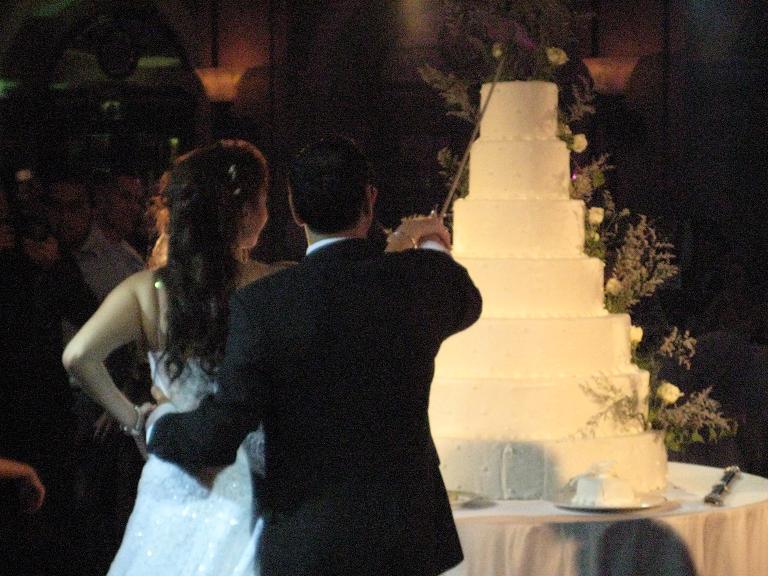
Cutting the cake

Wishing all my friends who got married this year luck and happiness in their marriages. Alf mabrouk!

Laat mij lekker!

Om niet volledig te verpieteren in Beirut, of tenonder te gaan aan alle chaos en lawaai, gaan Walid en ik regelmatig op excursie door het hele land. Libanon is niet groot (oppervlakte: een kwart van Nederland), maar rondrijden is vrij vermoeiend vanwege de slechte wegen, de ‘verkeersregels’ en het verkeer zelf. Om ervoor te zorgen dat niet één van ons volledig uitgeput raakt terwijl de ander vrolijk van het uitzicht geniet, wisselen we het rijden af. Voor Walid was dat, zeker in het begin, vrij eng, want hij was ervan overtuigd dat ik met mijn keurige Nederlandse rij-opleiding absoluut ongeschikt ben om het Libanese verkeer te trotseren. (Niets bleek minder waar – zolang ik maar in gedachten hou dat alle automobilisten hier ‘fietskoerier-gedrag’ vertonen.)

Het grootste problem was mijn gebrek aan toetergebruik. Wachten achter een taxi waar een passagier uitstapt? Toeteren om te laten weten dat ik erlangs wil. Auto in de buurt met de foto van een favoriete politicus? Riedeltje toeteren om te laten weten dat er mede-supporters op de weg zijn. Auto die rechts inhaalt en naar de linkerbaan zwiept? Niet inhouden – toeteren. Ik hield voet bij stuk in mijn opinie dat het land wel met wat minder toeteren afkan, en dat ik niet wil bijdragen aan al dat onnodige lawaai om ons heen. Redelijk als hij is, zag hij daar het nut wel van in, maar hij wilde me toch even meegeven dat het toeteren in Libanon meer is dan alleen waarschuwen voor gevaarlijke situaties: het is een volwaardig communicatie middel.

Blijkt het nog meer te zijn dan dat. Vanmorgen zaten we klem in het verkeer, konden niet links, niet rechts, niet rechtdoor, en de auto achter ons begon te toeteren. Ongeduldige, korte drukken op de claxon. Geagiteerd draaide Walid zijn raam open en riep hem toe: ‘Man! Ik zit klem! Wat wil je dat ik doe, op de volgende auto inrijden?’ Waarop de man uitstapte en terugschreeuwde:

‘Had ik het soms tegen jou?!? Ik was gewoon lekker aan het toeteren!’

Wij konden niet anders dan gierend van het lachen onze weg vervolgen.

Two options only

A ‘Green Line’ runs through Beirut, starting in Downtown and going South-East, separating the city and later on the country into two parts. East of the ‘line’ is Christian, West of the ‘line’ is Muslim. Although never an official frontier, its physical presence (stemming from the civil war) is still visible in many places in Beirut – certain houses on the roads that make up the line are still riddled with bullet-holes and signs of rocket-attacks. Yet even though the line is only visible in the city, I can never entirely forget about the division of the country. It’s not just the endless amounts of crosses and mini-Jesuses that decorate the roads in the Christian areas, nor the Ramadan banners in the Muslim areas. It’s me.

Being a tall, blond, European female means being subjected to many different stereotypes, depending on where I am in the world. In Africa it meant I was rich, in the USA it meant I was a model. In Lebanon, it can mean one of two things, and again, it depends on my geographical location.

In the Muslim areas of Lebanon, both city and country-side, it is automatically assumed that I am a journalist. After all, Lebanon is bursting at its seams with 20- and 30-something independent European females who want to report on the Middle East but do not have the freedom to do so in many other Arab countries. The stereotype is mainly annoying when I try to arrange a permit to South Lebanon, and have to explain why I would like to visit Hezbollah-favoring territories if not for media-related issues. On the streets, I don’t feel noticed, other than the occasional disagreeing look of a Muslim sheikh and his wife.

It’s a whole different story in the ‘other’ part of the country. Waiting for the bus on the street-side will inevitably result in several proposals that may or may not include cups of coffee or glasses of alcohol. Men who would otherwise never ask for directions feel compelled to back up and ask me ‘where is that shopping mall again? Oh, you don’t know? Where are you from then? Would you like to get in the car?’ I still don’t know where to look when the passing cars slow down for their ultimate staring and drooling experience. But the worst is when, like this weekend, we are trying to escape the heat in Beirut and spend the night in a hotel in Broummana. ‘Excuse me sir, the woman, who is she?’ ‘She’s my fiancée.’ ‘Ah ok. Mmmm. Let’s see. No, I’m sorry, we don’t have any vacancies.’ The accompanying look leaves room for no doubt that in his eyes, we are obviously lying, and Walid just picked me up from the street for $50 a night.

I know this is by far not the worst type of racism in Lebanese society. One only has to look at the malicious behavior towards the Sri Lankan maids and Bangladeshi gas-station attendants to see how much worse it can get. But it’s still hurtful, insulting and limiting; if given the choice between press or prostitute, I would still like to have the option to say ‘neither’.

Happiness in the Middle East

It’s the kind of information brought up in the bar, after a few drinks. ‘Hey guys, guess what, I read somewhere that the Lebanese are the least happy people in the Middle East.’ Hilarity all over. Really? Why would the Lebanese people be the unhappiest? Sure, there is a lot of fighting, war, explosions, bad electricity and thieving phone-companies, but still, most Lebanese are convinced they are the envy of the whole region, with everyone being jealous of the beautiful beaches and green mountains and sparkling nightlife and wonderful food… Well, apparently they aren’t. According to this report, the Saudis are the happiest. Speculation ensued over the reason why. The first question was, how could the people from Saudi Arabia and Bahrain be at the top of the list? Surely they must have forgotten to ask the Saudi women about their level of happiness, or maybe they stuck to the law and asked the women’s legal guardians: ‘Excuse me sir, on a scale of 1 to 10, how happy is your wife?’

But how could even the Palestinians rank higher on the happiness-scale? Maybe, it was argued, they were lumped together with the Israelis, and since it’s an Arab survey, they cannot use the name Israel. But would the Israelis be really happy with the way things are going there, even if they currently have the upper hand? ‘Well,’ was the final word on that ‘even if they aren’t, they can’t say so: they are the Chosen People, living in the Promised Land! How can they ever be unhappy?’

From the above arguments, it was deducted that the Lebanese might not be the most unhappy, but are rather the most honest people of the whole Middle East. Either that, or, as someone said, their low ranking should be attributed to their incredibly high expectations and disproportional sense of entitlement. I'm still undecided.

Polite conversation, translated.

- Morning of good- Morning of light Two mana’ouche zaatar, if you want - On my head Do you want anything in it? - No, I want your health in it - Love of my heart - Just add some olives for the master - Ok Here you go - May your hands be safeguarded - My dear - With safety - God is with you

(in Snack Faysal, Hamra, Beirut; Friday morning 15 August 2008)