Qussa

Stories from Afar & Up Close

… het is gewoon grappiger in het Nederlands

In 2006, voordat ik Walid kende, reed ik met mijn ouders langs een meubelwinkel hier in de buurt. Kijkend naar al die enorme, zware bankstellen en leunstoelen bekleed met donkergroen of rood fluweel, de gietijzeren koffietafels en de gouden draperieën verzuchtte ik: “Als ik ooit een Libanese vriend krijg, vraag ik me af hoeveel ruzies de inrichting van ons huis gaat opleveren.” Mijn moeder antwoordde daarop dat dat waarschijnlijk een van mijn minste zorgen zou zijn in een relatie met iemand met een andere culturele achtergrond. Desondanks was ik blij om al in een vrij vroeg stadium van Walid te horen dat hij erg gecharmeerd was van de Nederlandse manier van huizen inrichten, en niet zo van de Libanese manier, en we ontdekten al snel dat dat niet het enige vlak was waarop we het makkelijk eens werden. Onze smaken en ideeëen komen zo vaak overeens, zelfs, dat we vaak vergeten dat we een ‘multiculturele relatie’ hebben. Dat hij jonger is en korter, dat vergeet ik niet snel, maar het zijn vaak de vragen van anderen over ‘hoe dat gaat tussen ons’ die me eraan herinneren dat wij uit twee heel verschillende landen komen. Misschien helpt het dat Walid absoluut geen ‘typische Libanees’ is, zoals mijn mede-Nederlanders hier geoordeeld hebben, of dat, zoals ik mijn voormalig oppasmeisje uitlegde, onze ouders ons met dezelfde waarden en normen opgevoed hebben.

Alleen humor, dat blijft een lastig punt. Zoals ik al wist vanuit mijn studie Antropologie zijn grappen en grollen meestal de laatste horde die een immigrant moet nemen voordat van volledige intregratie sprake is, omdat die zo ontzettend sterk verbonden zijn met de geschiedenis, onuitgesproken vooroordelen en het ‘onderbuik-gevoel’ van een samenleving. Het is dus ook geen wonder dat als één van ons tweeën een grap vertelt, de ander daar meestal hoofdschuddend naar luistert en na afloop schouderophalend vraagt ‘was dat het?’ terwijl de verteller van het lachen bijna over de grond rolt. ‘Die grap is alleen leuk in het Nederlands/Arabisch,’ zeggen we dan maar, omdat ‘jij hebt gewoon geen gevoel voor humor’ niet echt bevorderlijk is voor de relatie – multicultureel of niet.
A mix of Italy and Belgium, with much better food

I’ve spent the past week touring around with two teenagers (whom I used to babysit, but who are now old enough to visit me in Beirut!), their mother and her partner. For five days, we drove to every corner of the country, tasted every dish available and discussed every topic related to the culture, nature and politics of Lebanon. The most intriguing part, according to them? Lebanese traffic. They were fascinated by the use of car horns instead of side-mirrors or indicator lights, the inability of the drivers to stay between two lines on the road, and the seeming absence of a maximum speed anywhere. The best thing of the trip, according to one of the teenagers, was the trip to Baalbeck. Not the ruins themselves, oh no, he meant the ride there on the mini-van. Why? It was just like a rollercoaster, lasting an hour and a half!

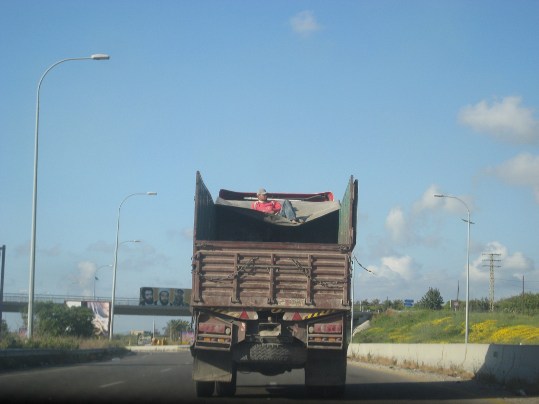
A good second was the way back from the South, where we ran into this gem:

transport-2

He seems quite comfortable there, doesn’t he? While that truck is going 100km/h on a three-lane highway… Overall verdict? It’s like a mix between Italy and Belgium, and we don’t know if that’s a compliment…

At the end of the line

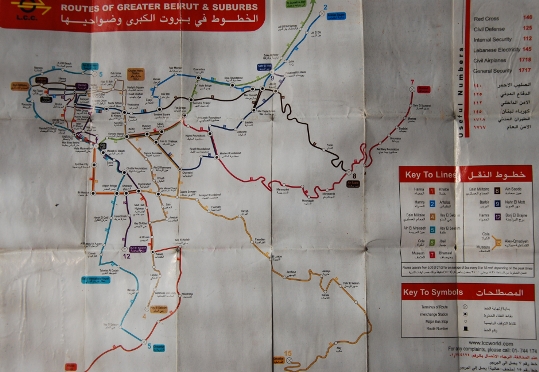
One of the things I have wanted to do since I got to Lebanon is to ride every line of the public bus-system from beginning to end. Many Lebanese people try to tell me there is no public transport in Lebanon, but I regularly take the bus, so I know this to be incorrect. However, I didn’t manage to convince anyone of the contrary until I got hold of this map:
dsc_0005


Yes, that is a route map for almost all lines operating in Beirut. Now since this is Lebanon, of course it is not as straightforward as this piece of paper would have you believe (there are competitors in beige-colored busses who go the same routes but take shortcuts if they think they can make more money that way, for example; and there are times when the bus driver has a bad day and refuses to go the last few kilometers if he only has one or two passengers), but in general the system works quite well: you pay 1000 liras (€0.50) when you get on, and you can stay on the bus until he turns around to go back.

It’s usually fun to be on the bus. It goes slow, so you see a lot along the way (and by slow, I mean really, really slow), and you often meet people. Since it is such a cheap way of transportation, a large part of the passengers are foreign workers (Sri Lankans, Ethiopians, Syrians) going to town on their day off, which makes for many smiles and a festive atmosphere. There’s never a dull moment: I’ve had a bus driver offering everybody a coffee his local roadside coffee-stand, a bus driver who sang hymns with his passengers, a bus driver who made an extra stop to get his green beans for dinner, and a bus driver who passed by home to pick up his kid (asking one of the passengers to go to the 3rd floor to tell them to hurry up). Unfortunately, I’ve also had a bus driver drinking beer, a bus driver who blocked another one’s way, jumped out of the bus and beat him up, and a bus driver who threatened to slap a Sri Lankan woman because she refused to give her seat to a Lebanese passenger (I still regret not speaking up then).

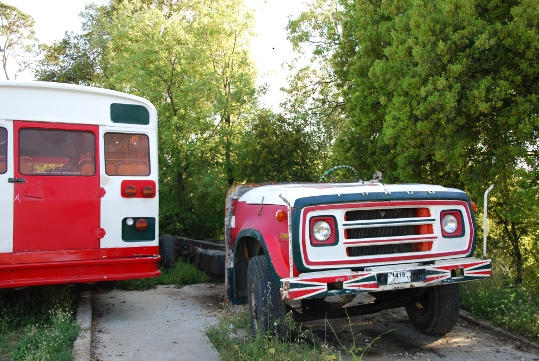
In general, however, I like to ride the bus, in all its dirtiness, dustiness and brokenness. And at the end of the line, there’s always a surprise. Here’s what I found in Bhalnes:
dsc_0007


Half a bus! Doesn’t that make you want to get on the road with the glorious L.C.C., the Lebanese Commuting Company? (Not to be confused with the L.T.C., which is, as I understood, the only true public transportation – the L.C.C. is a privatized copy installed by Hariri.)

So, corruption…

On Monday, I came back from a vacation in the Netherlands and at my brother’s farm in Serbia to an unpleasant surprise: a problem with my visa for Lebanon. My passport was confiscated, and the next three days I spent in the offices of the Security General, running from room to room, waiting in the hallways, getting questions and stamps and signatures and more questions. All these hours, Walid’s mother was with me, asking around, translating, waiting with me, explaining my situation, repeating over and over again that I was her future daughter in law and she would not let me be kicked out of the country just like that. It took three days for them to give me a decision (get married as soon as possible or leave the country within two months), and it’s still unclear what the problem was. It might be that I didn’t accept an offer from someone within General Security to pay for something I didn’t need a while ago in the visa process, when it was unclear if I should pay for what I did need at that moment. According to a Dutch guy I spoke to during this whole process, that’s exactly where I had gone wrong: I should have gone along with the offer of the Security General employee, because ‘you know how it goes here, they’re all corrupt and you just have to go with it.’ Well no, I don’t know that that’s how it goes here: in my experience, the people at the General Security offices have usually been very clear in stating what the rules and procedures are and what I need to bring or pay for things to get done. When a friend once tried to help me get in through the back door, they politely refused and told me where to go for the regular procedure. This may not be everybody’s experience, but that doesn’t mean that ‘in reality, they are corrupt,’ and I am naïve for thinking otherwise.

Of course I’m not stupid or blind. I know there is plenty of corruption, in Lebanon and elsewhere. But I do not believe that Lebanese people are inherently corrupt, or that things here can never change. That’s why the Dutch guy’s words hit me on another level as well: I find it incredibly condescending to speak this way about Lebanese society, as if people here are incapable of change or improvement. I also find it strange that people who would never even consider offering a policeman in their own country some banknotes to forget about the rest of the fine think nothing of doing so when they are in Lebanon, as if it doesn’t take two for corruption to continue; those in power, and those who want something from them. Yes, there are some people who are corrupt no matter what, but it is my firm belief that most people are mainly corrupt if the situation arises – I mean, why not accept that $100 bill somebody is offering you, if eventually you will have to give him or her the stamp anyway?

And of course I know there are always two things to consider in such situations, and that these two things are not necessarily in agreement at all times: in this case, my own stance against corruption, and the fact that I needed to get something done (a visa to stay in Lebanon) from a possibly corrupt guy. Although not entirely on purpose, I am glad that in this case I did not contribute to corruption, and can do nothing but bear the unfortunate consequences - or convince my fiancé that a Sunni marriage certificate isn’t so bad after all. As the lieutenant signing the final decision said: You know, you should get married soon anyway. You have a very good mother in law!