Qussa

Stories from Afar & Up Close

Filtering by Category: Typical---

De vijanden van Geert

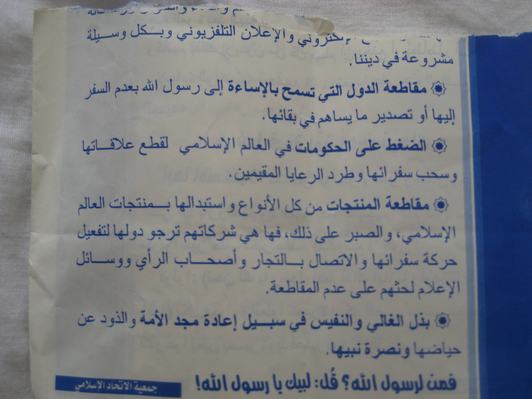
Vanuit Nederland kreeg ik de volgende link opgestuurd: Wilders is not Holland.” Wat ik me afvraag is of de ondertekenaars diezelfde nuance aanbrengen als er ergens een ‘terrorristische aanval” is gepleegd in de naam van God en iedereen om het hardst roept dat “de Moslim-gemeenschap” zich daar openlijk van moet distantiëren. Kennelijk snappen wij Nederlanders zelf nog niet dat een individu niet noodzakelijkerwijs de hele groep vertegenwoordigt, en nu het ons betreft moeten we dat met een website aan de rest van de wereld uitleggen. Mijn lerares Arabisch heeft dat in elk geval wel begrepen. Ziedend kwam ze binnen met een pamflet dat ze op straat van “zo’n bebaarde man met een jurk” had gekregen. Zie hier de laatste geboden zoals opgesteld door een paar studenten van de hoogste Soennietische religieuze authoriteit:

Pamflet

U zult geen contact hebben met landen waar de profeet Mohamad (vrede zij met hem) beledigd wordt, U zult alle economische banden met deze landen doorsnijden, U zult uw ambassadeurs terugtrekken, en U zult werknemers uit dergelijke landen ontslaan. Het papier verscheurend zucht mijn lerares: “Zulke mensen maken bijna dat ik me schaam om Soenniet te zijn. Maar dan hoop ik maar dat iedereen begrijpt dat zulke groeperingen ook niet alle Soennieten vertegenwoordigen”.

Mijn collega’s hebben een praktischere oplossing: “We zullen die man wel eens een email sturen met argumenten tegen zijn betoog. Woorden moet je met woorden bestrijden; hij is niet zoals Amerika dat Israel financieel ondersteund. Dan heeft economisch boycotten zin. Nu gaan we gewoon lekker een stukje Nederlandse kaas kopen.”

I believe this is what we call ‘irony’

The Lebanese are an opinionated people. (According to many of my friends, this is the reason I feel so at home in Lebanon.) (Many of my friends could very well be right.) And the Lebanese are specifically opinionated about themselves and their society. “We are like this”, they will say, or “we are like that.” As an anthropologist, I also have an opinion about Lebanese people, or rather, about Lebanese society. It is based on doing fieldwork here, combined with anthropological, sociological and psychological theories on why people do what they do and act they way they act. However, this opinion does not always correspond to the opinion a Lebanese person may have of his/her society. And when a discussion comes to a point where people say ‘We do this because we are like this’ and I say ‘well, I think you do this because you are like that’, it usually ends with the ultimate dead-end argument from the Lebanese person I am speaking to: “But you don’t know, you can’t understand, because you are not Lebanese.”

It's an argument I obviously cannot refute.

Recently, I participated in a workshop about collaboration between NGOs in Lebanon (of which there are a stunning 3000 to 4000 registered with the Ministry). We learned how to initiate, manage and sustain collaborations between NGOs of different backgrounds and with different goals and missions.

On day 3 of the workshop, it became clear we wouldn’t have time to cover all the subjects our American trainer had in mind, so she drew up a list of the remaining topics and let us choose, collectively, which ones would be dropped.

It didn’t take long for the group to decide that we didn’t need to learn ‘communication skills’, nor learn more about ‘conflict resolution’. The general argument: “We know all that already.”

I could hardly keep myself from asking “really? Is that why we still haven’t elected a president and are on the brink of a (civil) war?”

But I can’t say that. Because I’m not Lebanese…

On the road

It’s one of those things I have come to accept as a normal part of daily life: checkpoints. I pass by least 3 of them on my way to work. Some are standard, fixed in one place; others appear and disappear in unexpected places along the road, lasting a few hours or a day. Most are manned by the army or the police, a few by ‘internal security forces’ or, rarely, customs officers. They can be part of the scenery, with warning signs half a kilometer ahead, concrete roadblocks lined up to steer the cars in the right direction, and a little sentry box covered in the colors of the Lebanese flag to shelter the officer on duty from possible rain; they can also be haphazard constructions of crush barriers blocking the road to a point where cars have to slow down to a snail’s pace to slalom around them. The cars are usually directed towards the left side of the road, leaving the right side open for those whose drivers are pulled over. A soldier to the left, machine-gun in one hand, peeking into every car, signaling with the other hand to continue driving or stop for a closer inspection of the car and its passengers. About 20 meters ahead another soldier holding a spiked barrier on wheels, to be thrown in front of the wheels of those ignoring the orders of the inspecting officer; on the right a few uniformed men walking around, checking car-papers, driver’s licenses, passports, identity cards, trunks and car-hoods.

When passing a checkpoint, the driver is supposed to come to a near halt (without actually stopping), with the window on the driver’s side rolled down and the volume of the radio at its lowest. If motioned to drive on, a ‘thank you’ is in order. Having a majority of female and/or blond passengers usually warrants unhindered passage, but cars full of young men almost always get directed to the side, and so are delivery vans and pick-up trucks.

I am still trying to find out what they are searching for. Clearly, these checkpoints are intended to make the country more secure, but how exactly they contribute to the overall safety – I don’t know. Do they want to intercept smuggled weapons? Stop boys from joining their friends in a fight? It seems that only men and immigrant workers (Ethiopian, Sri Lankan and Filipino women) pose a threat to society, because they are the ones who have to show their identity papers at the rare occasions that the (mini)bus gets pulled over. And apparently I am the least dangerous of all, because even when all the other females on the bus were asked to show identification, the soldier looked at me once and ignored the passport I tried to hand him.

Lebanon wouldn’t be Lebanon if the Lebanese wouldn’t know their way out of the hassle. With a car full of cameras and other equipment, we were sure of a spot in the inspection line, yet when our driver opened his window and the soldier said ‘good morning, where are you going with that?’ it took us only 7 words to make him grin from ear to ear, nod his head in agreement and let us pass. What we asked? ‘Sorry sir, are you from the Bekaa-valley?’ Yes, he was, and coincidentally from the village next to that of the driver.

Another strategy, to be used in case of forgotten IDs, is ‘ask before they ask’: when you get to the checkpoint, you ask the soldier about the road ahead, and (hopefully) he will get so caught up in explaining it to you that he will completely forget to ask for your papers. This does not always work, however, as we realized when we got lost in the hills of South Lebanon and asked to soldier about the way to Tyr last summer. ‘Of course we know the way,’ he said, throwing a look inside the car, ‘but first we would like to get to know the boys a bit better.’

Cup of coffee... I hope you are hungry.

In Lebanon you will never die from a lack of food. All you have to do is visit a colleague who is staying home after she had surgery on her nose. Or your neighbor. Or your friend’s parents that you haven’t seen in 2 weeks. Or anyone you ask for directions on the street. Hello! Welcome, welcome! What a surprise to see you! - Thank you, thank you, so good to see you too, are you feeling any better yet? Oh, it’s ok, come in, come in! Sorry for the cold, there is no electricity so please keep your coat on. Have a seat, please, have seat! Would you like to drink anything? Coffee, tea, nescafé? - No thank you, I’m fine. Here, we brought you some sweets from Saida. Thank you! So nice of you. So what would you like to drink, coffee, tea? - Nothing, really, thank you, we just had lunch. Nothing? Come one, a cup of nescafé? Some juice? - I’ll have a glass of water then, thank you. Maryam, bring our guests a glass of water please. [the daughter comes in with tall glasses full of juice] Here you go, a glass of orange juice. Would you like some of our sweets? Or here, take some nuts! - Thank you, that’s very kind, but I just ate, I’m really full. That’s ok, just take some of our dessert, it’s homemade, see, cream with nuts on top! Here you go, have some. [serves a big portion on a plate] Oh and have you ever tried these cookies? They are typical for this region, made with dates and sugar. - I will try one, thank you, but really I am not hungry at all as I just had lunch… Ah yes, true. Well, this is good for dessert, I bet you have never tried it before, they are chocolates with nuts that we serve when someone gets engaged. Our nephew got engaged last weekend so we have a whole basket of them, would you like to take some with you? Here, take a handful for the road. Oh, you finished your juice! Maryam, please bring our guests some more juice. - I am sorry, thank you, but I am not thirsty, just a glass of water would be very nice. Alright, a glass of water it is. [comes back with a tray with coffee and tea] Here, have a coffee. You don’t drink coffee? You would prefer nescafé? No nescafé? Ok tea then, here you go, with a few spoons of sugar – I will only put two spoons, I know you foreigners don’t like sweet tea that much. So how are you?

It never becomes normal, either way

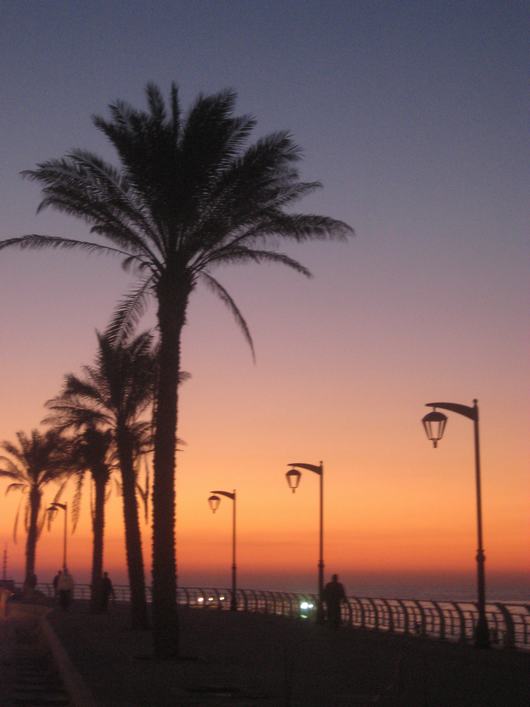
I don't know if I shouldn't be used to it by now: the beautiful sunset on the Corniche (yes, I was there again), and the fact that right after I took this picture two soldiers with their weapons ready in front of them demanded to see what I was taking pictures of. Well, of the view: Sunset on the Corniche

Even though I see it almost every night, I never get bored of it. And remember I told you about the famous Lebanese Lie, the idea that in this country, one can ski and swim on the same day? Well, this night I was proven wrong: to my right, I saw the mountains covered in snow, and to my left, I saw a couple of old men taking a dive in the sea. Not sure if they had been skiing in the morning of course, but they could have been...