Qussa

Stories from Afar & Up Close

It's a Classic!

dsc_0010a


Did I get it right? Did I manage to get every single myth and stereotype of Beirut into one picture? I would almost think so:

- A church AND a mosque in one shot? Check - An ugly, modern high-rise juxtaposed with an old crappy building? Check - Some reconstruction going on? Check - A bit of nature and (almost) sunset to add a romantic atmosphere? Check

Seems like I’ve got a classic on my hands here.

And for some more ‘we all know what Beirut is like’, head over to this blog: Jad Aoun is handing out ‘Looks Like Beirut Awards'. Brilliant.

Identity-crisis, live at ABC

It’s not easy for kids in Lebanon these days – so many languages, so many nationalities per person! Yesterday morning, as we were having a late breakfast in ABC-mall in Ashrafiyeh, we were joined at the big table by a family of four; mother, father and two sons of around 4 years old. They seemed to be Lebanese, mostly speaking French, while the mother tried a sentence or two in Arabic with the kids. One of the boys kept staring at me until he decided he needed some answers and turned to his parents.

‘Mom, dad, which country are we from?’ ‘We live in France, and we are from Lebanon.’ ‘Oh.’ He turned back to me. ‘And you, where are you from?’ ‘I am from The Netherlands,’ I answered. ‘To the North of France,’ clarified his dad.

The boy, still wondering about the complexities of different countries of origin and nationalities, brought the discussion on their side of the table to their friend Gael, whose mother was said to be French. She also, it was mentioned, has blue eyes, and eventually one of the sons asked:

‘So when we go back to France, will we have blue eyes as well?’ As if the whole confusion of correlation between language, residence and descent wasn’t enough yet...
Libanopoly, or: be your own Saniora

A while ago on a sunny evening-walk, we passed an old, crowded toy store. As we’d been trying to find affordable board games, we hopped in. The owner of the store told us he had been a shopkeeper in Ras Beirut since 1983 – and he had the photos to prove it.

dsc_0106

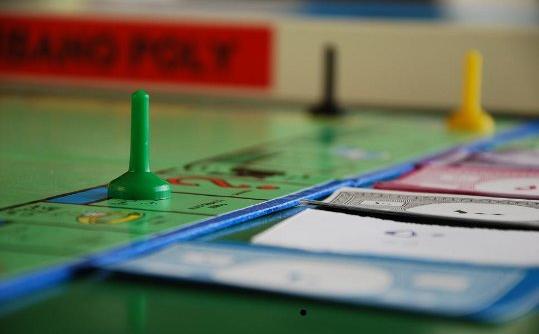
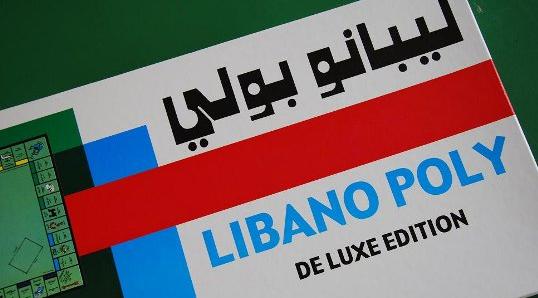
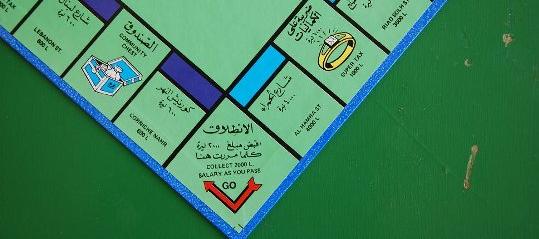
He also had a very large selection of toys and games, ranging from fake barbies to small tanks made from shiny bullets glued into shape. He also had the Lebanese version of Monopoly: Libanopoly. Only 13500 liras (about $9), for the deluxe edition! That game was coming home with us.

dsc_0097

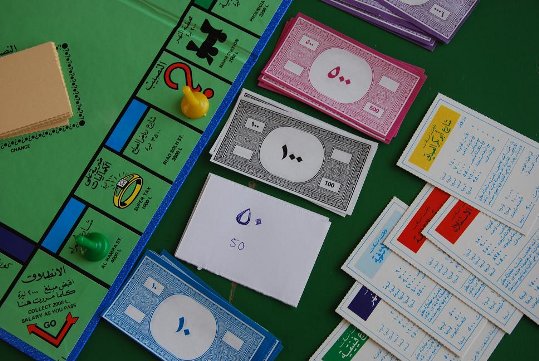
Unfortunately ‘deluxe’ turned out to be a euphemism, seeing that the game had a grand total of 4 plastic thingies to represent the players, a collection of melted plastic squares representing the Beirut housing market and a total absence of 50-lira bills, but that’s like living here in real life: adapt, find a solution and play (live) on!

dsc_0110

The best part, of course, are the inevitable jokes: can I run up a debt of 40 billion dollars? If another player threatens my position, can I blow up his token? I can probably build more than the maximum allowed number of houses on this street, right? That, and the fact that Hamra Street is the most expensive street on the board. I’ve always known I live in a classy neighborhood…

dsc_0099

Land van Babel

Ik had een afspraak op een school in een dorpje ten Noorden van Beiroet, in de bergen. Zoals gebruikelijk was ik ruim op tijd vertrokken omdat ik niet precies wist waar de school was, en ik zo rustig de weg zou kunnen vragen – een slimmere strategie dan te proberen je locatie op de kaart te vinden of vantevoren een routebeschrijving te vragen, want dan raak je sowieso de weg kwijt. Ik ben eraan gewend, de weg vragen. Meestal probeer ik het eerst in het Arabisch, en als dat geen resultaat oplevert ga ik over op Frans (in de overwegend Christelijke gebieden) of Engels (in de overwegend Moslim-gebieden). Mijn avonturen vonden dit keer plaats rond Bikfaya, ook bekend als het Christelijk hart-land, dus het zou wel Frans worden.

De eerste wegwijzer was een vrouw op leeftijd die langs de kant van de weg wandelde met een boodschappentas. Ze zag mij al van verre aankomen en glimlachte vriendelijk toen ik stopte en het raampje open draaide. Haar gezicht betrok toen ik in het Arabisch vroeg of ze wist waar die-en-die school was. ‘Geen idee,’ zei ze in het Frans, ‘ik ben hier ook pas net aangekomen.’ Met vinnige passen liep ze door.

Een eindje verderop vond ik een benzine-station. Ik tankte, en besloot meteen maar in het Frans te beginnen met mijn vraag over de juiste afslag. De medewerker van het pompstation keek me verschrikt aan, stamelde ‘ik spreek geen Engels!’ en rende weg om zijn baas te halen. Die wist me in een mix van Frans, Engels en Duits een eind in de goede richting te helpen.

Tot de laatste splitsing in de weg – moest ik links of rechts? Ik wilde niet het risico lopen weer verkeerd te rijden, dus ik parkeerde de auto en ging een stomerij binnen voor advies. ‘Spreekt U Arabisch of Frans?’ vroeg ik, voordat ik uberhaupt over de weg zou beginnen. ‘Engels, graag’ zei de man met een vriendelijke glimlach.

Het zal je niet verbazen dat de school drietalig bleek te zijn.