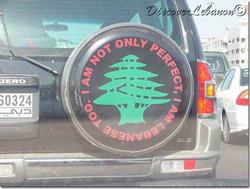
Sietske asked ‘how do you know when the ship is sinking?’When do you know the country is descending into war?
Maybe when you ask for the prices of membership at a new gym, and their promotional talk starts with “Fitness First is proud to be the only gym in Lebanon with the guarantee that we will always be open; explosions, unrest – we might have special opening hours, but we will never be closed!”
Or maybe when a friend replies to your complaint that it is hard to find a job with “Don’t worry, there will be a war soon, and you will work as a reporter.”
Walid, who is in Amsterdam and reads the news every night as soon as the newspapers publish their content online, is almost certain that the presidential elections will be a breaking point and that a regional war is looming on the horizon. The USA and Iran (aside from Afghanistan and Iraq, let’s not forget), Syria and Israel (which is already busy on the Palestinian front), different parties inside Lebanon backed by different powers outside of the country… the tensions are running high and violent conflict is likely. Yet I told Walid he is reading too many newspapers, scaring himself needlessly.
I remember the feeling: in January of this year, while I was quietly writing my thesis in Amsterdam, riots broke out at the Arab University of Beirut. There was nothing I could do but watch CNN, seeing the neighborhood I had lived next to turn into a scene of rock-throwing, car-window smashing groups of men, shot at by snipers on several balconies, ultimately dispersed by the army. Although it wouldn’t do anything to change the situation, I checked the news every few minutes, paralyzed on the couch, unable to concentrate on writing. And the anchorwoman kept asking the reporter: “Do you think this is the start of a new civil war?”
Until the moment my plane landed in Beirut, at the beginning of this summer, I constantly told myself that the situation could change at any time, thus preventing me from coming here. Like Walid, I read the news daily, searching for clues as to when the war would start – there was no doubt in my mind that it would, it was only a matter of ‘before or after my arrival’. It didn’t happen. There has been an attack on the Spanish UN convoy in South Lebanon, there was a war in the Palestinian camp Nahr el Bared in the North, and an assassination of a politician, but nothing has turned the country into yet another Middle Eastern battleground.
This is not to say it won’t happen. Yet when reading the news, war can become an abstract phenomenon, something that is decided upon by the powers that be, something detached from the countries it takes place in. It looses its day to day reality of people living a life despite the fear, the threats, the anticipations, the paranoia; the damage, suffering and death. When I think of Iraq, I try to think of all those people going to school, to work, to the market, and I wonder how they deal with their fear, I try to imagine how, for them, war is their life, not an abstract issue on a page of the newspaper.
Then I often end up trying to imagine what that life would be like here, if there would be a war. Will it be like the stories I heard and read from the war of 1975-1990, with fights between militias in certain areas (the radio announcing which streets are safe), snipers shooting everyone moving within target-range, random checkpoints of militias and people being kidnapped for ransom? Or will it be more like what we hear from Iraq, with suicide bombers and car bombs in markets and other public places? Which areas will be affected most, where (if so) will the fighting take place? My neighborhood, Hamra, is a mixed neighborhood and politically not very outspoken – will it remain semi-neutral and thus livable? How will I live it, providing I stay here and stay alive?
It is strange and unsettling to ask myself these questions, but sadly enough it is unavoidable.
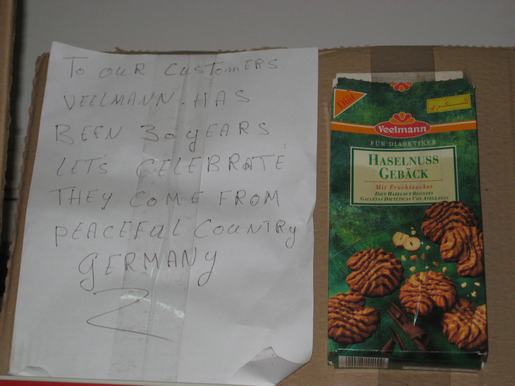
(This beautiful, handwritten note in the local supermarket says: To our customers: Veelmann has been 30 years, let's celebrate they come from peaceful country Germany. The note appeared last year, a few days after the end of the war, and is still there...)

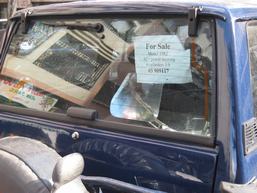

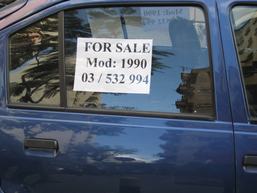
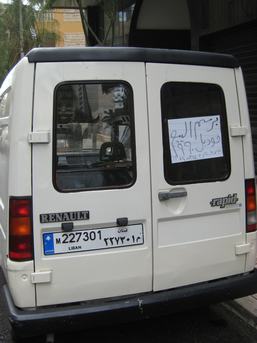
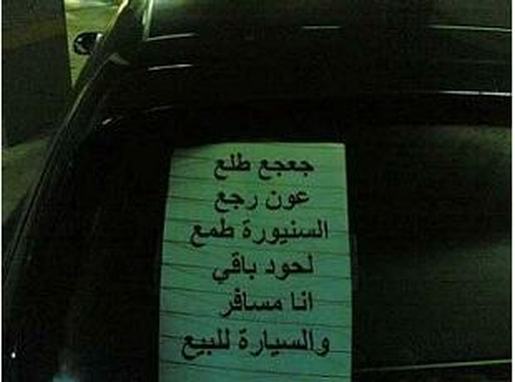 (Translation, by Walid: "Jaajaa is out, Aoun is back, Sanioura has become greedy, Lahoud is staying, I am leaving, and the car is for sale." - the 4 mentioned are Lebanese politicians.)