Qussa

Stories from Afar & Up Close

Back in Beirut

The biggest drawback of living in a city is the lack of privacy. From my shared apartment to the Corniche (the entertainment-value of which I have described before), there are people everywhere, so there is no space where I can sing along with the music on my mp3-player without getting some funny looks, or requests to stop the noise. Except today. I came back to Lebanon yesterday and I noticed that the city wasn’t as bustling and noisy as I remembered it. Apparently, Beirutis are afraid of the cold (it is –cough– a chilling twelve degrees celcius.) So tonight, when I went to the Corniche for a run, I took my chance: it was dark, the seaside boulevard was almost deserted, and the few people there I could see from far ahead. The cars parked next to the sidewalk with people watching an empty sidewalk all had their windows closed, so I cranked up the volume on my player and burst out in an ABBA-song. Keeping an eye on the kissing couple against the railing and the lonely jogger I came across to lower my voice on time not to scare anyone, I thought I had the situation completely under control.

Unfortunately, I had forgotten about that one little feature that is part and parcel of life in Beirut: an armed soldier on every streetcorner. Not that the Corniche has any corners, but it does have trees. And right when I took a deep breath to scream out ‘SOS! When you’re gone, how can I even try to go on’ I heard loud laughter behind me – and I turned around just in time to see the tip of a machine gun disappear behind a palmtree.
Lebanese lies

One of the most annoying things of living in Lebanon as a foreigner is that when you meet people for the first time, they will either try to convince you that you are crazy for wanting to live here, of they will try to ‘sell’ their country to you (neither of which has worked with me, just yet). Being crazy refers to the fact that, according to many Lebanese people, living here means you have to put up with Lebanese people, which can be a bit of a challenge. It also means you can be hit by a car at any moment or die because a passing politician is blown up right next to you. Those who try the positive approach usually come up with lame stereotypes such as ‘It’s a great place to live because we all speak 3 languages; English, French and Arabic. For example, we say ‘hi, kifak, ça va?’ To be honest, in more than 12 months in Lebanon, I’ve heard this phrase exactly once. Other than that, mixing words from 3 languages doesn’t mean you speak 3 languages, as far as I know – unless we would consider Dutch people tri-lingual because they use words like ‘shit’, ‘sorry’, and ‘überhaupt’ in their everyday speech. But I digress.

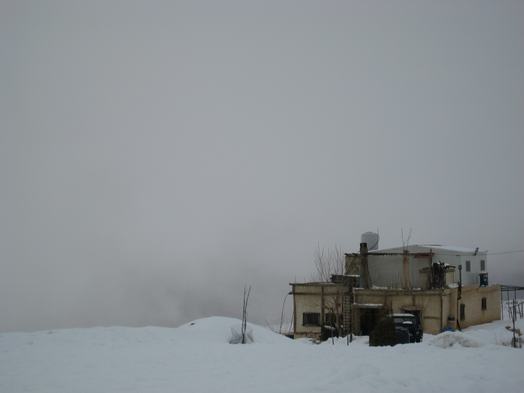
The other thing people like to boast about is the fact that one can ‘ski in the mountains and swim in the sea’ in the same day. Again, I have only heard once of people who did this (and they only did it to prove this claim is true). Usually, it is either too cold to swim, or there is not enough snow to ski. Yesterday it may have been possible though – judging from Sietske’s pictures, the weather was quite warm in Beirut, whereas we were up in the Cedars (around 2000m. above sea level), and this was our view:

Snow in the Cedars

For me, the temperatures up there felt like practicing for tomorrow: return to The Netherlands, for a few weeks. What's left for me now is to wish everyone Adha Karim, Merry Christmas, and a wonderful 2008. Until then!

Reflections on an assassination

Saturday. My dad calls and asks: ‘So how is Beirut today?’ I feel the oh-so-familiar knot tying itself in my stomach – I’ve been out all morning and haven’t checked the news yet, so who knows what has happened. ‘Why, did they blow up someone else?’ ‘Well, the guy from three days ago…’ Ah yes. The guy from three days ago (now almost a week). François el Hajj, a general in the Lebanese Army, mentioned as a possible successor to Michel Sleiman (the current commander of the army), if Sleiman indeed becomes the next president of the Lebanese Republic. He came from a poor family in the South, el Hajj, and as one of 10 children this job represented a rare chance for someone of his background to make it to the top. In Rmeish, his village in the South, there was even talk of him becoming president, eventually – for a commander of the Army, necessarily a Maronite Christian, not a strange career-move in Lebanon.

I arrived to work Wednesday last week to find one of my colleagues crying. ‘The explosion this morning, it was her uncle’, whispered another colleague to inform me. Other than her red, teary eyes, there was nothing that day that reminded me of the awfulness of what had happened that morning. Nothing on the streets, nothing in the conversations – not even the loud accusations of Syria, the country that gets blamed first (and exclusively) for every assassination, by members of the current government.

One of my colleagues thought it was because he was from the army, and the army is supposedly ‘neutral’ in Lebanon – neither with the government, nor with the opposition – so if you have no political party to stage the mourning for your martyrdom, your death hardly receives any public grief.

Yet the silence over el Hajj’s murder, the absence of government-members blaming Syria, might have another source: apparently, el Hajj refused to join the ‘Southern Lebanese Army’, an armed group that helped the Israeli army, when Israel invaded Lebanon in 1982. Being from a village on the border with Israel, he has seen the destruction and aggression from Lebanon’s Southern neighbor, and his moral stance against Israel hasn’t changed over the years. This means that having him as the leader of the Lebanese Army (which is deployed in South Lebanon to prevent Hezbollah from re-arming, or even disarm them) might be disadvantageous to countries other than Syria, to put it mildly.

Question remains: who blew him up? Maybe this time, we shouldn’t look to the East for an answer…

Broodnodig (even iets heel anders)

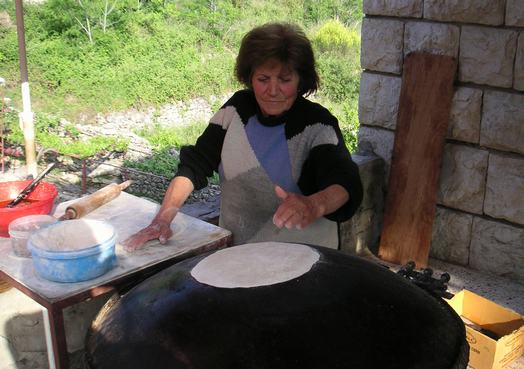
Het was zomer 2005, mijn eerste bezoek aan Libanon, en Reina en ik reden door een achterafstraatje in Beirut toen ze plotseling stopte naast een mannetje op een fiets. Over zijn stuur hingen doorschijnende plastic zakken met wat leek op bruine lappen. Reina gaf de man 1000 lira (€0.50) en kreeg een zak aangereikt, die ze achteloos op de achterbank gooide. “Dit is mijn favoriete brood", zei ze, "dit vind je nergens buiten Libanon.” Saj

Veel Libanese gerechten worden met brood geserveerd; de bekendste daarvan ongetwijfeld de hommus en moutabbal (aubergine-dip, ook bekend als baba ganousj) waarbij het brood niet weg te denken is. Maar een echte Libanees laat het daar niet bij: die eet ook de salade met een stuk brood in de hand, en de kip, en dient de gegrilde stukjes lamsvlees op gewikkeld in brood. En de broodconsumptie neemt alleen maar toe naarmate men verder richting het Zuiden gaat: tegen de Israelische grens aan wordt zelfs de spaghetti met brood in plaats van een vork gegeten.

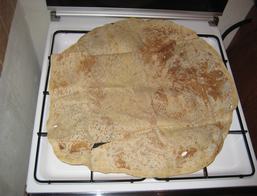
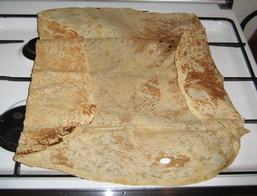
Stap 1 Stap 2

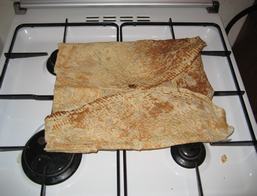
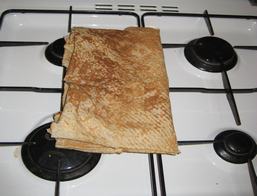
Dat het hier niet om bruine boterhammen gaat moge duidelijk zijn. Over het algemeen gebruikt men groot uitgevallen pita-achtig brood, platter en van pizzaformaat, maar elke streek kent haar eigen variatie. Zo eet men in het Noorden brood dat heerlijk smaakt, maar de textuur heeft van een zeem, en is het Zuiden gespecialiseerd in mar’ou’, een soort flinterdunne lap die op plaatsen doorschijnend is. Het wordt gebakken op een saj, een ronde, bolle ijzeren plaat die van onderen verhit wordt, en het eindproduct heeft qua doorsnee de afmeting van een vierpits gasfornuis. Da’s natuurlijk lastig transporteren, vandaar de foto’s van origami met mar’ou’ op deze pagina: een snelcursus in ‘van saj naar diepvries-formaat in 5 stappen’.

Stap 3 Stap 4

Zie? Blijft bijna niks van over! Eindproduct

If I could choose…

For today, the homework for English class was to write a few lines on ‘if I could live in any country in the world, I would choose…’. I present you with a random sample of the choices of the 9-year old students of Rawdah HS Elementary school in Southern Beirut:

“…I would choose Spain, because my parents studied there and lived there for 15 years and they speak very good Spanish.”

“…I would choose Denmark, because I have the Danish nationality, and it is a very green and peaceful country.”

“…I would choose Dubai, because my father and my uncles work there, and they cannot travel to Lebanon often.”

“…I would choose London, because the schools are free, there is no pollution because of smart actions of the government, and because the roads are good and very far from the houses so you can have calmness in your living room.”

While the first three choices point mercilessly at the rather saddening exodus of Lebanese people that is going on and has been going on for decades, the last one just makes me nod my head in agreement. I can’t wait to spend some time in a city that does not have honking cars everywhere, all the time…