Qussa

Stories from Afar & Up Close

Dit is geen rode verf

Het was de laatste dag van A’shoura vandaag, en dus togen mede-blondie Sietske en ik naar Nabatiyeh. Tijdens A’shoura herdenken de Shi’ieten de dood van Imam Hussein tijdens de slag bij Karbala (wat ook wel wordt gezien als het beslissende moment in de opsplitsing van de Moslim-gemeenschap in Soennieten en Shi’ieten). Niet dat we nou zo rouwig zijn om de dood van Imam Hussein, maar een goed potje volksvermaak is nooit weg en in Nabatiyeh zijn we daarvoor aan het juiste adres, want daar gebeurt dat herdenken op de meest extreme manier: mannen vergieten hun eigen bloed om het lijden van de Imam tot uitdrukking te brengen. [Dit bloedvergieten wordt trouwens niet door iedereen gewaardeerd: mijn – Shi’ietische – vrienden vroegen me vertwijfeld waarom ik toch altijd die rare dingen wil bekijken (tja, antropoloog hè, zeg ik dan) en noemen het ‘disgusting’; mijn collega’s vinden het wel amusant dat ik het wil zien, maar vergeten niet en passant te melden dat zowel Fadlallah, de hoogste religieuze autoriteit in Libanon, als Nasrallah, de leider van Hezbollah, deze manier van A’shoura ‘vieren’ ten zeerste afkeuren. Verschillende organisaties hebben dan ook tenten opgezet langs de route van de processie waar mensen hun bloed kunnen doneren: een nuttigere vorm van bloedvergieten.]

Zoals je kunt zien in het fimpje zijn er verschillende manieren om deel te nemen aan de processie: sommige mannen slaan zichzelf op het hoofd, anderen gebruiken de platte kant van een zwaard, weer anderen slaan zichzelf op de rug met een ijzeren ketting – al komt dat in Nabatiyeh maar weinig voor. Vóór vertrek wordt er bij hen die willen bloeden een snee op het hoofd gemaakt met een paar tikjes van een scheermes. Vervolgens moet er onophoudelijk op het hoofd geslagen worden, anders stolt het bloed en houdt het op te stromen. In het begin van de dag zijn het met name de kleine kinderen die een rondje lopen, ondersteund door trotse ouders, maar in de loop van de ochtend zwelt de menigte aan tot een paar honderd mannen, die in groepen van enkele tientallen (in bedwang gehouden door de brancards van het Rode Kruis) door de straten gaan. Een omgang rond het grote plein (zandvlakte) in Nabatiyeh begint en eindigt meestal in de moskee, waar aan het eind van de dag het bloed letterlijk van de trappen af stroomt.

De rest van de gemeenschap, veelal zwart gekleed als teken van rouw, kijkt toe vanaf de rand van de weg of balkons en daken van omliggende huizen, en maakt foto’s ter meerdere eer en glorie van de bloedende mannen. Ter lering ende vermaak wordt op het centrale plein in een theatrale opvoering de slag bij Karbala nagespeeld – dit jaar helaas zonder levensechte veldslag en de knapste man van Nabatiyeh als Hussein op het paard, zoals Sietske mij beloofd had. Tot mijn grote verdriet heb ik het einde van het stuk niet kunnen zien, want net toen Hussein op het podium zijn familie voorbereidde op een martelaarsdood, werd de ijzerige geur van bloed me teveel en belandde ik bijna uitgestrekt op een brancard bij één van de Rode Kruis-posten (vrees niet, zover is het niet gekomen, de stoeprand bood uitkomst).

Kortom, het was me het dagje wel. Tot slot nog een paar foto’s, gewoon voor de leuk (niet voor hen met een zwakke maag):

Bebloede processie Hoofd snijden met scheermesje Modieuze chica’s nemen foto’s van de helden De menigte Bebloede mannen Meer bebloede mannen Het toneelstuk Toeschouwers op het dak De trap van de moskee In de moskee

Het kan altijd erger

Faysal (u misschien welbekend uit eerdere verhalen) was er altijd van overtuigd dat hij niet in Libanon zou blijven. ‘Ik haat dit land!’ was zijn meest gehoorde uitspraak, meestal gevolgd door een variatie van ‘ze zouden alle Libanezen moeten afknallen!’ Myrna en ik moesten dan ons uiterste best doen om hem ervan te overtuigen dat er ook leuke dingen zijn in dit land, namelijk, euh... bijvoorbeeld... nou ehm, wij twee waren er toch? Goed, ik was dan wel een onzekere factor, maar Myrna was vastbesloten in Libanon te blijven. Ze vond het pijnlijk te zien hoe de ene na de andere land- en leeftijdgenoot de hoop opgaf dat het ooit beter zou worden, en vervolgens naar de Golf, Europa of Amerika verhuisde om daar een nieuwe baan – en misschien wel een heel nieuw leven – te beginnen. Nu zijn de rollen omgedraaid. Niet dat Faysal het land meer waardeert, maar hij heeft een baan gevonden in Beirut die hij voor geen goud kwijt wil, zelfs niet als zijn immigratiepapieren voor Canada (waar hij al zo’n zes jaar op zit te wachten) eindelijk verwerkt en goedgekeurd worden. Myrna’s optimisme heeft echter geen stand weten te houden; de explosies en politieke onbereidheid tot een oplossing voor de crisis te komen hebben ook haar liefde voor Libanon weten te bekoelen. Gelukkig is ze onlangs getrouwd, en woont de kersverse echtgenoot in het buitenland. Koffers inpakken en gaan, is dan meestal de procedure. Maar Myrna heeft pech. Zij heeft het gepresteerd om Libanon in te ruilen voor Saoedi-Arabië. Dat betekent dat haar man naar Libanon moet komen om haar op te halen, want alleen aankomen op het vliegveld is niet de bedoeling. Het feit dat ze een ondertekende verklaring van haar vader moet hebben om uberhaupt toestemming te krijgen naar het zanderige koninkrijk af te reizen, belooft ook niet veel goeds. Ziedend was ze, dat ze met haar 29 jaar en een master's in dermatologie nog te infantiel wordt geacht haar eigen beslissingen te nemen.

Maar ondanks haar woede over deze vereisten probeert ze het zelf positief in te zien: ‘In de compound [waar alle buitenlanders wonen] kun je gewoon doen wat je wil, echt, het is lang zo erg niet als het lijkt. Tijdens mijn laatste bezoek [net na het huwelijk] heb ik zelfs de eerste 24 uur geen abaya gedragen!’ Dat klinkt veelbelovend, tot we horen dat ze in die 24 uur van het vliegveld naar huis is gereden – midden in de nacht – en de rest van de tijd binnenshuis heeft doorgebracht. Misschien dat het went, zo’n zwarte jurk, maar ik kan me maar moeilijk aan de indruk onttrekken dat ze hier iets slechts voor iets nog slechters heeft ingeruild...

Back in Beirut

The biggest drawback of living in a city is the lack of privacy. From my shared apartment to the Corniche (the entertainment-value of which I have described before), there are people everywhere, so there is no space where I can sing along with the music on my mp3-player without getting some funny looks, or requests to stop the noise. Except today. I came back to Lebanon yesterday and I noticed that the city wasn’t as bustling and noisy as I remembered it. Apparently, Beirutis are afraid of the cold (it is –cough– a chilling twelve degrees celcius.) So tonight, when I went to the Corniche for a run, I took my chance: it was dark, the seaside boulevard was almost deserted, and the few people there I could see from far ahead. The cars parked next to the sidewalk with people watching an empty sidewalk all had their windows closed, so I cranked up the volume on my player and burst out in an ABBA-song. Keeping an eye on the kissing couple against the railing and the lonely jogger I came across to lower my voice on time not to scare anyone, I thought I had the situation completely under control.

Unfortunately, I had forgotten about that one little feature that is part and parcel of life in Beirut: an armed soldier on every streetcorner. Not that the Corniche has any corners, but it does have trees. And right when I took a deep breath to scream out ‘SOS! When you’re gone, how can I even try to go on’ I heard loud laughter behind me – and I turned around just in time to see the tip of a machine gun disappear behind a palmtree.

Lebanese lies

One of the most annoying things of living in Lebanon as a foreigner is that when you meet people for the first time, they will either try to convince you that you are crazy for wanting to live here, of they will try to ‘sell’ their country to you (neither of which has worked with me, just yet). Being crazy refers to the fact that, according to many Lebanese people, living here means you have to put up with Lebanese people, which can be a bit of a challenge. It also means you can be hit by a car at any moment or die because a passing politician is blown up right next to you. Those who try the positive approach usually come up with lame stereotypes such as ‘It’s a great place to live because we all speak 3 languages; English, French and Arabic. For example, we say ‘hi, kifak, ça va?’ To be honest, in more than 12 months in Lebanon, I’ve heard this phrase exactly once. Other than that, mixing words from 3 languages doesn’t mean you speak 3 languages, as far as I know – unless we would consider Dutch people tri-lingual because they use words like ‘shit’, ‘sorry’, and ‘überhaupt’ in their everyday speech. But I digress.

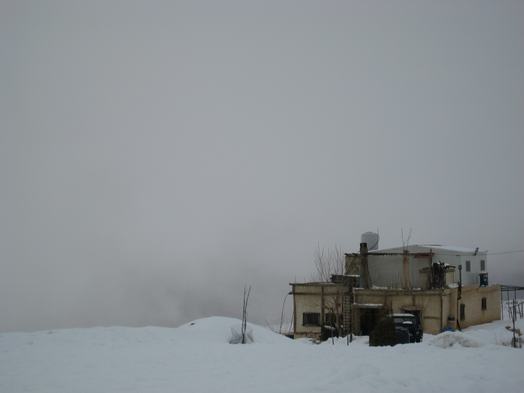
The other thing people like to boast about is the fact that one can ‘ski in the mountains and swim in the sea’ in the same day. Again, I have only heard once of people who did this (and they only did it to prove this claim is true). Usually, it is either too cold to swim, or there is not enough snow to ski. Yesterday it may have been possible though – judging from Sietske’s pictures, the weather was quite warm in Beirut, whereas we were up in the Cedars (around 2000m. above sea level), and this was our view:

Snow in the Cedars

For me, the temperatures up there felt like practicing for tomorrow: return to The Netherlands, for a few weeks. What's left for me now is to wish everyone Adha Karim, Merry Christmas, and a wonderful 2008. Until then!

Reflections on an assassination

Saturday. My dad calls and asks: ‘So how is Beirut today?’ I feel the oh-so-familiar knot tying itself in my stomach – I’ve been out all morning and haven’t checked the news yet, so who knows what has happened. ‘Why, did they blow up someone else?’ ‘Well, the guy from three days ago…’ Ah yes. The guy from three days ago (now almost a week). François el Hajj, a general in the Lebanese Army, mentioned as a possible successor to Michel Sleiman (the current commander of the army), if Sleiman indeed becomes the next president of the Lebanese Republic. He came from a poor family in the South, el Hajj, and as one of 10 children this job represented a rare chance for someone of his background to make it to the top. In Rmeish, his village in the South, there was even talk of him becoming president, eventually – for a commander of the Army, necessarily a Maronite Christian, not a strange career-move in Lebanon.

I arrived to work Wednesday last week to find one of my colleagues crying. ‘The explosion this morning, it was her uncle’, whispered another colleague to inform me. Other than her red, teary eyes, there was nothing that day that reminded me of the awfulness of what had happened that morning. Nothing on the streets, nothing in the conversations – not even the loud accusations of Syria, the country that gets blamed first (and exclusively) for every assassination, by members of the current government.

One of my colleagues thought it was because he was from the army, and the army is supposedly ‘neutral’ in Lebanon – neither with the government, nor with the opposition – so if you have no political party to stage the mourning for your martyrdom, your death hardly receives any public grief.

Yet the silence over el Hajj’s murder, the absence of government-members blaming Syria, might have another source: apparently, el Hajj refused to join the ‘Southern Lebanese Army’, an armed group that helped the Israeli army, when Israel invaded Lebanon in 1982. Being from a village on the border with Israel, he has seen the destruction and aggression from Lebanon’s Southern neighbor, and his moral stance against Israel hasn’t changed over the years. This means that having him as the leader of the Lebanese Army (which is deployed in South Lebanon to prevent Hezbollah from re-arming, or even disarm them) might be disadvantageous to countries other than Syria, to put it mildly.

Question remains: who blew him up? Maybe this time, we shouldn’t look to the East for an answer…