Qussa

Stories from Afar & Up Close

Filtering by Category: Typical---

Ordinary things

I never thought I would get used to things like these, but strangely enough they have become normal: • that when I try to make a phone call and the call doesn’t get through because the network is jammed, my first thought is ‘oh, they probably blew up another politician’ • that every morning when I wake up, I go to the bathroom first to see if there is water to take a shower or flush the toilet (one day out of two) • that there is a guy in a green or grey camouflage suit on almost every streetcorner, a heavy machinegun dangling in his hand, his finger on the trigger • that I hear people on the street greet each other with ‘Hi! How are you? So, when will the war start?’ • that when we hear rattling sounds coming from the hills between our office and the Israeli border, my colleagues shake their heads and say ‘It’s nothing, just some anti-aircraft fire.’ • that I make sure not to use the elevator to my apartment on the 7th floor around 9am, 12pm or 3pm, because these are the times at which the daily 3-hour electricity cut can start • that half of the roads around my house are completely barricaded with concrete blocks at night and turned into zig-zag tracks by day because they are close to one- or another politician’s house • that on my way to work I pass by at least 4 tanks, strategically positioned on major crossroads in Beirut, with a guy on top loosely aiming his machinegun at passing cars • And lastly, that guys start singing when I walk past them.

Sometimes I wonder if I should be worried that these things no longer shock, anger or surprise me….
This is how we do it

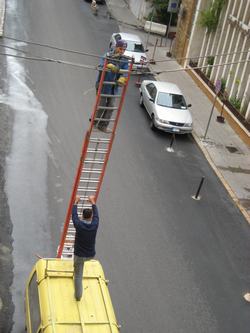
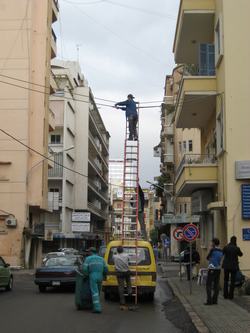
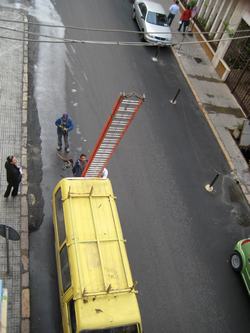
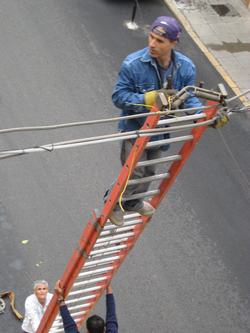
It is still not quite autumn, but the rains have started. They come in short, heavy bursts, and if you are indoors the whole day, you may not even notice it has rained. Except for that one little problem, that typically Lebanese problem, that is called the electricity system. As if there weren’t already enough things wrong with it, the rain will break down the last working connection. The wire, hanging loosely over the street, will crackle and sputter, then a big flash – and it’s gone. But, no need to worry: we call uncle Hassan, who comes with his son, a neighbor and ladder to fix the cut ends of the electrical cable.

Down there Up here

In The Netherlands, we have laws (called Arbowet) to regulate labor and the circumstances surrounding labor. Workers have to be safe at all times, wear protective clothing, be prevented from making movements that may cause injuries. For example, those working at the check-out in the supermarket are not allowed, by law, to reach further than 30cm to pick up the articles they need to scan, thus hopefully avoiding the risk of straining the arms of the cashier.

Uncle Hassan is not so concerned with these things, and neither are his workers: the yellow piece of old copper-wire and the son standing on the roof of the van holding the ladder are deemed adequate safety-measures. So up went the neighbor, pulling some wires, tugging on the remaining cables to check their sturdiness, preventing any further damage from rain. Done.

When told about the Dutch Arbowet and the 30cm limit reach, the reaction was a smug laugh. “Your country must be so easy to occupy!”

The whole thing From behind

Hussein's Koninkrijk

Het is Hussein’s kleine koninkrijk, zijn mini-bus. Lang en gespierd, met kort zwart haar en een perfect geknipt sikje, staat hij naast de bus te wachten op zijn passagiers. Hussein neemt niet zomaar iedereen mee naar Sour (Zuid Libanon), net zomin als hij zomaar overal onderweg stopt om mensen uit te laten stappen. Andere mini-bussen rijden over de kustweg, elkaar aftroevend in snelheid en roekeloosheid om maar zoveel mogelijk passagiers uit de dorpen langs de route mee te kunnen nemen, maar Hussein heeft dat niet nodig. Hussein heeft zijn vaste klanten, hij hoeft onderweg niet uit het raam te hangen, zijn bestemming roepend om nog net die ene extra reiziger op te pikken. Hussein’s bus weerspiegelt zijn zelfverzekerde houding. Andere mini-bussen zijn oud, gebutst, en gedeukt aan alle kanten – de verf afgebladderd, stoelbekleding meer af- dan aanwezig, ramen die niet open of dicht kunnen en kapotte ruitenwissers, spiegels en hoofdsteunen. Aan Hussein’s felrode bus is geen mankementje te ontdekken, er is geen deukje in te ontwaren. De zwartleren bekleding is glanzend schoon, er zijn geen kruisjes, zwaardjes of beschermende stenen oogjes die aan de achteruitkijkspiegel bungelen, zelfs het dashboard is minimalistisch leeg. Twee clips en aan bakje houden de bankbiljetten en munten op orde en de radio wordt bediend met een afstandsbediening.

De brede stoep waarvandaan de minibussen uit Beiroet vertrekken is, als elke dag, een grote chaos. Hussein steekt boven de menigte uit, dus hij ziet me al van verre aankomen en wenkt me de bus in. “Komen je collega’s ook vandaag?” vraagt hij. “Dan wachten we nog even.” Andere chauffeurs schreeuwen tegen hem dat hij moet vertrekken, zijn bus is bijna vol! De rest van de passagiers kan hij onderweg wel oppikken! Maar Hussein reageert niet eens. Als de laatste vaste klant de schuifdeur achter zich heeft dichtgetrokken vertrekken we in volle vaart. Eenmaal op de snelweg komen de Celine Dion cd’s uit het dashboardkastje, waar ze rustig lagen te wachten bovenop de Koran, tussen de Pussy Cat Dolls en Arabische techno.

Hussein werpt een tevreden blik in de achteruitkijkspiegel. 140km per uur, en hij heeft zijn schaapjes op het droge.

Marriage Proposal (type 1)

I am in the backseat of a service (shared taxi). The last passenger has just gotten out and we are stuck in traffic. The driver turns around and says, in his best English:- “Where you from?” - “I’m from The Netherlands, from Holland…. From Amsterdam.” - “You visit here in Lebanon?” - “No, I live here. I live in Beirut.” - “Aaaaahh! You like Lebanon?” - “Definitely. I love it.” The driver then tries to look at my ring finger, but traffic starts moving so he has to turn around to keep at least one eye on the road. - “You married?” Time for a little lie. - “Yes, I am.” - “He is from Holland? Yes?” - “No, he is Lebanese.” - “Ahh! Very good. You have children?” - “No. …I mean, not yet.” - “Ok later, inshallah.” - “Yes. Inshallah.” Silence returns to the car. Then a sudden turn of the driver, who asks me in Arabic, with twinkling eyes: - “Do you have any problems with your husband?” - “No; no problems. Why?” - “Well, if you do, just come to me. I will marry you!”

Wat een wasta / living the Lebanese Dream

Ik heb een baan gevonden. Of eigenlijk, iemand anders heeft voor mij een baan gevonden. De moeder van een vriend is bevriend met iemand in de board of directors van een prestigieuze NGO (non-gouvernementele organisatie) in het zuiden van Libanon, en dus kan ik daar aan de slag, als antropoloog en website-verbeteraar. De waardering van mijn vrienden is groot. Niet zozeer vanwege de baan zelf (al lachen ze zich rot dat ik nu daadwerkelijk een verblijfsvergunning voor Libanon ga krijgen), maar meer vanwege de connecties die ik kennelijk heb, die me deze baan bezorgd hebben. ‘Bij die NGO?!? That’s some powerful wasta!’, was de eerste reactie op het heugelijke nieuws; ik kreeg direct bonuspunten voor mijn ‘Libaneesheid’ dat ik mijn wasta (nuttige connecties / netwerk) goed genoeg had weten te gebruiken om er een baan uit te slepen.

En nu? Nu werk ik 6 dagen per week overdag bij de NGO, en ’s avonds en zondagochtend geef ik Nederlandse les, alle uren bij elkaar opgeteld net genoeg salaris om van rond te kunnen komen. Zoals Jamil vriendelijk glimlachend zei: ‘Now you are living the Lebanese dream!