Qussa

Stories from Afar & Up Close

Parking Lot Romance

It was 7.30am when the doorbell rang. It was A…, one of the boys from the parking next to our building, with a small note in his hand. It read:

I’m always fine, tnx, and how about u how are u 2? how’s ur leg now? & you said you want me 2 ur friend? sure we just friend. by the way I’m C…… how about you what is your name? …

A…. is one of the many Syrian men who work the jobs most Lebanese don’t want to do; usually in construction, or parking cars in the temporary parking lots that are created on demolition sites.

Their situation is, in some ways, similar to that of the maids from Ethiopia, Sri Lanka or the Philippines: they are young and come to Lebanon alone to make some money and then go back home. In the few hours they have off per week (work at the parking lot starts at 7am and ends at 9pm, 7 days a week), they hang out with their compatriots – I don’t think mingling with the Lebanese would be much appreciated, knowing how classist Lebanese society is. The same goes for the maids: they have possibly even less hours off, but on their free afternoon (often Sunday), they can often be seen hanging around the store that sells products from their home-country, or making phone calls from the payphone on the corner.

Now people are people (even when they are considered slaves), and it is no surprise that A… has lost his heart to one of the Philippine girls walking past the parking lot with the groceries every day. The only problem? He doesn’t speak much English, and she doesn’t speak much Arabic. How he had managed to write her the initial note, I don’t know, but he came to us with her answer and asked us to write her a reply.

Hello C……., sorry it took me so long to write back. I’m A….. I would like to see you more often. I think you are very cute. Maybe you can teach me English and I will teach you Arabic.

May romance blossom.

Season's Greetings - last week's worth

Thursday - the Prophet’s Birthday: call all Muslim friends to congratulate them. First check if the Sunnis and Shi’a agree on this date since the Shi’a are always a little later with those things. Friday - Mother’s Day: call all my friend’s mothers who have ever said ‘I am your mother in Lebanon’, plus all my female friends who have children, to congratulate them. Not my own mother, though, because where she lives, Mother’s Day is in May.

Sunday - Easter: call all my Christian friends to congratulate them. Oh wait, no, only my Catholic/Maronite friends, the Orthodox celebrate it three weeks later.

Happy days for everyone. And a big egg from the streets of Damascus (Syria).

Vrolijk Pasen!

Guess what I'll be doing today...

It’s off to the beach, baby! Lekker weertje

Other than that: My apologies for those of you who read my site through any type of newsfeed or outside reader and have been seeing rows and rows of awful links at the bottoms of my most recent posts. My blog apparently has a security problem (am working on fixing it), which not only causes these links to appear every few hours, but also turns off the possibility to leave comments. I’m sorry, and I hope it will be repaired soon…

De vijanden van Geert

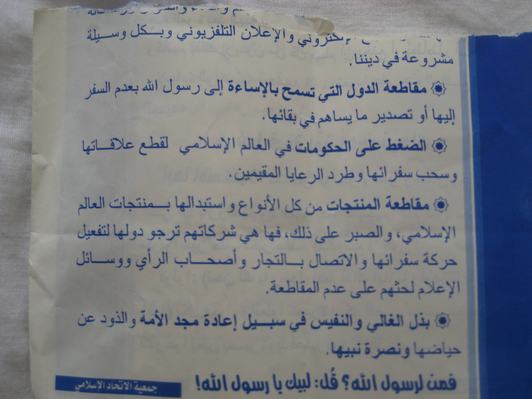
Vanuit Nederland kreeg ik de volgende link opgestuurd: Wilders is not Holland.” Wat ik me afvraag is of de ondertekenaars diezelfde nuance aanbrengen als er ergens een ‘terrorristische aanval” is gepleegd in de naam van God en iedereen om het hardst roept dat “de Moslim-gemeenschap” zich daar openlijk van moet distantiëren. Kennelijk snappen wij Nederlanders zelf nog niet dat een individu niet noodzakelijkerwijs de hele groep vertegenwoordigt, en nu het ons betreft moeten we dat met een website aan de rest van de wereld uitleggen. Mijn lerares Arabisch heeft dat in elk geval wel begrepen. Ziedend kwam ze binnen met een pamflet dat ze op straat van “zo’n bebaarde man met een jurk” had gekregen. Zie hier de laatste geboden zoals opgesteld door een paar studenten van de hoogste Soennietische religieuze authoriteit:

Pamflet

U zult geen contact hebben met landen waar de profeet Mohamad (vrede zij met hem) beledigd wordt, U zult alle economische banden met deze landen doorsnijden, U zult uw ambassadeurs terugtrekken, en U zult werknemers uit dergelijke landen ontslaan. Het papier verscheurend zucht mijn lerares: “Zulke mensen maken bijna dat ik me schaam om Soenniet te zijn. Maar dan hoop ik maar dat iedereen begrijpt dat zulke groeperingen ook niet alle Soennieten vertegenwoordigen”.

Mijn collega’s hebben een praktischere oplossing: “We zullen die man wel eens een email sturen met argumenten tegen zijn betoog. Woorden moet je met woorden bestrijden; hij is niet zoals Amerika dat Israel financieel ondersteund. Dan heeft economisch boycotten zin. Nu gaan we gewoon lekker een stukje Nederlandse kaas kopen.”

I believe this is what we call ‘irony’

The Lebanese are an opinionated people. (According to many of my friends, this is the reason I feel so at home in Lebanon.) (Many of my friends could very well be right.) And the Lebanese are specifically opinionated about themselves and their society. “We are like this”, they will say, or “we are like that.” As an anthropologist, I also have an opinion about Lebanese people, or rather, about Lebanese society. It is based on doing fieldwork here, combined with anthropological, sociological and psychological theories on why people do what they do and act they way they act. However, this opinion does not always correspond to the opinion a Lebanese person may have of his/her society. And when a discussion comes to a point where people say ‘We do this because we are like this’ and I say ‘well, I think you do this because you are like that’, it usually ends with the ultimate dead-end argument from the Lebanese person I am speaking to: “But you don’t know, you can’t understand, because you are not Lebanese.”

It's an argument I obviously cannot refute.

Recently, I participated in a workshop about collaboration between NGOs in Lebanon (of which there are a stunning 3000 to 4000 registered with the Ministry). We learned how to initiate, manage and sustain collaborations between NGOs of different backgrounds and with different goals and missions.

On day 3 of the workshop, it became clear we wouldn’t have time to cover all the subjects our American trainer had in mind, so she drew up a list of the remaining topics and let us choose, collectively, which ones would be dropped.

It didn’t take long for the group to decide that we didn’t need to learn ‘communication skills’, nor learn more about ‘conflict resolution’. The general argument: “We know all that already.”

I could hardly keep myself from asking “really? Is that why we still haven’t elected a president and are on the brink of a (civil) war?”

But I can’t say that. Because I’m not Lebanese…