Traffic in Lebanon is chaotic, to put it mildly. Major crossroads in Beirut are puzzles of honking cars, inching around each other, blocking everyone's way, trying to get to the other end in complete disregard of all the other traffic. Sometimes, there is a policeman trying to bring some order to the chaos, but more often than not the assigned officer gives up after half an hour of being completely ignored, yelled at and (almost) driven over. I don't blame the poor guys - getting Lebanese people in cars to follow a certain structure, the personal benefit of which is not immediately clear, is an impossible task indeed.
But what do I know? Today my service-driver swirved his way around garbage-bins, passed two cars on the right and then threw his steering wheel all the way to the left to switch lanes and get across the intersection. One of the passengers pointed at the policeman who was frantically waving his stick to get people to follow his directions. 'Uh huh,' said the driver, 'if I do what he says, I will never get across!' 'Yeah,' added the other passenger with an accusing nod of the head towards the officer, 'have you noticed? There's always a traffic-jam when there is a policeman trying to arrange traffic!'
I guess it's the Lebanese version of the chicken-and-egg conundrum.
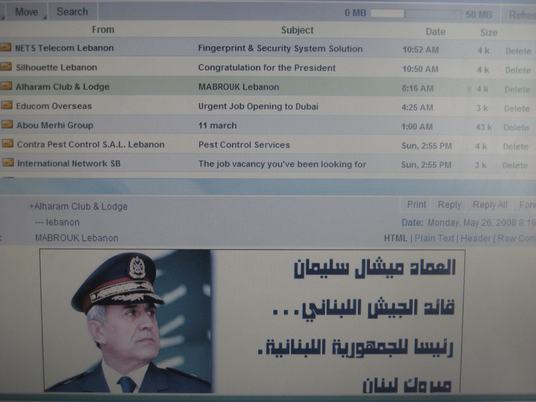
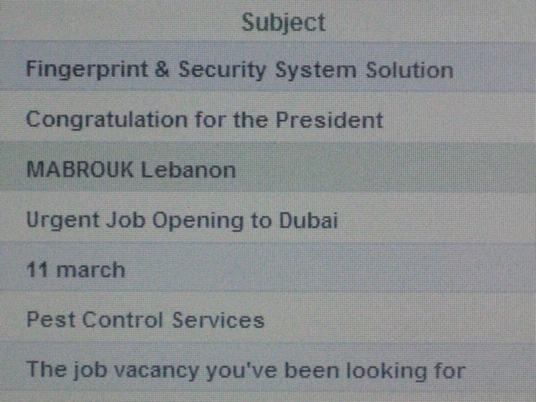
It is with pleasure and anticipation that I open my email-inbox at work every morning. Not because of the amount of interesting letters, but because of the advertisements. The spam messages for blue pills and other body-part enhancing potions that I find in my private mail are useless compared to the advertisements I receive at the work-address. The offers for explosion-proof cars, announcements about vacancies in Saudi Arabia, and messages urging me to join the gym to look good for summer – they are a perfect way to keep up with the situation in the country without having to read the newspaper or watch the news on TV. Unrest and economic malaise? Increase in job-offers in the Gulf. Explosions and car-bombs? Increase in gadgets to detect explosives before they set off. Violence in the streets? Increase in options to shatter-proof your windows. Agreement reached in Doha? Book your table now at your favorite restaurant – and don’t forget the option of plastic surgery before bikini-season.
So are you curious to know how Lebanon is doing these days? Just take a peek at my inbox of this morning:
Ik las het op de BBC website, woensdagochtend, maar kon het niet geloven totdat ik mijn collega’s hoorde juichen en klappen: ‘Accoord bereikt in Libanese crisis’. Mijn collega’s waren niet alleen in hun euforie: bij aankomst op het busstation in Beiroet werd ik onthaald met een hartelijk “has du es gehört? Qatar has unser Konflikt beended!” door de pompstationhouder die maar niet kan onthouden dat Dutch niet hetzelfde is als Deutsch, en de buschauffeur riep elke paar minuten “Sleiman wordt president! Sleiman is mijn oom! MIJN OOM WORDT PRESIDENT!”, gevolgd door een waslijst aan zaken die nu beter zouden worden, inclusief een lagere benzineprijs.
Dus zover is het gekomen: voor één keer heeft geen enkele politicus zich uit het overleg teruggetrokken, stampvoetend dat hij zijn zin niet krijgt; voor één keer is er doorgepraat en doorgeonderhandeld tot er een vorm van overeensteming bereikt is; voor één keer hebben de politici gewerkt aan waar ze voor aangenomen zijn: oplossingen zoeken voor wat er mis is in Libanon – en heel het land loopt juichend op straat. Velen zijn ervan overtuigd dat dit het einde is van alle problemen, dat de economie zich snel zal herstellen nu de tenten van de sit-in in Downtown zijn verdwenen, dat niemand meer zal vechten en niemand meer opgeblazen zal worden, met auto en al.
Het doet me denken aan een email die ik ooit kreeg, een verhaal over een studente die een brief stuurde aan haar ouders:
‘Hier een verslag van mijn eerste jaar aan de universiteit.
Sinds een paar maanden ga ik niet meer naar college. Ik heb een jongen ontmoet, hij werkt op het pompstation om zijn schulden af te betalen (schulden van gokken en drinken). Ik ben zwanger van hem en werk nu in de kantine van een groot bedrijf om in ons onderhoud te voorzien. ...
... Nee hoor, bovenstaande is niet waar. Het nieuws is dat ik het afgelopen semester alleen maar onvoldoendes heb gehaald, maar dat klinkt jullie nu waarschijnlijk als muziek in de oren!’
En zo ook in Libanon. Het feit dat ze de kiesdistricten zó ingedeeld hebben dat je nu al weet dat jouw stem maar half zoveel telt als die van het andere deel van de stad, lijkt misschien niet zo heel belangrijk als dat betekent dat de schietende mannen onder je balkon weggaan. Dat het hele akkoord (inclusief de formatie van een zo mooi klinkende ‘Overheid van Nationale Eenheid’) de religieuze/sektarische scheidslijnen alleen maar verder verdiept, is ook iets van later zorg. De stilte van het uitblijven van schoten, granaten en autobommen, en daarmee de illusie van vrede en economische voorspoed, klinkt dan inderdaad als muziek in de oren. Voor even. Tot je je realiseert dat een ‘voldoende’ voor inzet nogsteeds een dikke onvoldoende als resultaat kan betekenen.
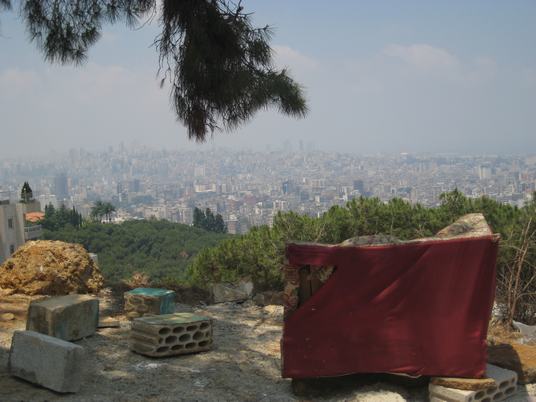
Should new clashes / another civil war break out, I know I have a place from where to watch it all :
Beirut, as seen from the mountains. The workers at the construction site told me I could come and enjoy the view from there. They even promised me the comfy chair.
Photo taken in Fanar, east of Beirut, May 18th 2008.
Imagine you are colleagues. You see each other almost every day, you spend more hours together than you do with you family. You have different political opinions, but it doesn’t matter – as long as you don’t talk about it, except for a small joke every now and then – you get along very well. You even become friends, in the way that colleagues do, because over time you learn so much about each other’s lives.
Then, one day, you can’t go to work. The roads are blocked, gunmen are outside your house, cars are set on fire. You hide inside with your family – your mother, your father, your brother and your son – while rockets are being fired from your building into the one across the street. Everybody is scared, trying to hide in ‘safe places’ (the rooms with no windows), angrily watching the news as the events unfold. It’s one political side against the other.
Your colleague is in another neighborhood, also forced to stay inside. You send each other an sms each day, for the basic information: Are you still alive?
The day arrives that everything calms down enough to return to work. But what are you going to say? The bullets that landed on your balcony were fired by gunmen of the party your colleague supports, the rocket that burned out your neighbor’s apartment came out of their RPGs. You know your colleague survived, but you heard her uncle died. His car was riddled with bullets by fighters from your side of politics. How can you talk about all this? You know that any mention of the events will be met with a staunch defense of their party’s role and reasons, and you know you will feel compelled to do the same if they tell their stories.
So you both remain silent. You give each other a smile and carry on where the work had been left off. The anger, the hurt, the fear that you experienced – you can’t find a way to share all of it with these people so close to you. Similarly, you do not hear about their anger, their hurt, their fear of the past few days. But what is left without these emotions? How can you sympathize when you don’t know the other person’s pain and worries? Will it still be possible to see them as friends, or even humans, if what remains for you to see and know is merely the physical expression of a political party you despise?
Or will you turn to ‘co-existence’, an innocent-sounding phrase that another blogger describes as “a Trojan horse filled with many bloodlusting soldiers ready to come out and murder the Lebanese people in their sleep”? And this is why it’s over, but it isn’t. Because as that same blogger says: “This phrase is saying: ‘We acknowledge that we have sectarian and religious differences, but we must ignore them and live together in peace.’ [But] a country is not built on mutual ignoring of differences. A country cannot be built on the fact that its denizens look at each other with scrutiny and hate. A country cannot be built until its citizens accept each other for who they are.”
[more than 200 000 martyrs / more than 3700 bombed cars / more than 1 000 000 emigrants / and still we haven’t learned / it’s enough] [clip "from all Lebanese for all Lebanese"]