Qussa

Stories from Afar & Up Close

Merry Christmas from Oosterhout

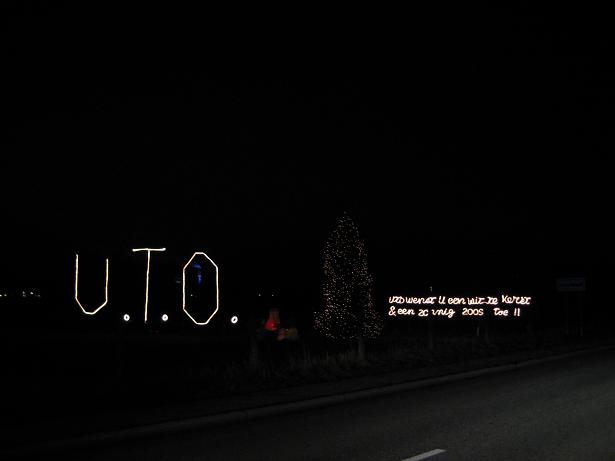
On the road to my parents' village, Oosterhout (in the east of the Netherlands), the youth group of the Catholic church has placed a big sign made of strings of lights that says: simg_4981

U.T.O. wishes you a white Christmas and a sunny 2009!

I know there is always something to laught at here, so I asked what U.T.O stands for. It used to be ‘Ultra Terror Oosterhout,’ was the answer. I can only assume the name was chose in a time that no one in the village mastered the English language.

The pastor must have done some research, because he adviced them to change the name. U.T.O. now stands for ‘Uiterst Trots Oosterhout’ – Extremely Proud Oosterhout. I sure hope they didn’t get their inspiration here, but I wouldn’t be surprised.

Either way, I wish you all a merry Christmas and a great start to 2009! Hope to see you here!

This Country Is Too Small And I Have Proof (bonus edition)

Currently on vacation back in the Netherlands, I am meeting with a student who would like to do research for her Master's thesis in Lebanon. I ask her if she has been to Lebanon before. She has; once on a few days with her parents while she was spending some time in Syria, and then again for a true Beiruti party-night on invitation of a guy they met randomly that first weekend. But the guy is not very useful as a contact for her research, she thinks, he seemed to be a bit too much on one side of the political spectrum. Her research is rather political and will require careful balance.

We get to the practical things she will have to arrange, and I tell her I know an international student house where a room might be available. I once lived there, but I don’t know who to contact for it now, because the friend I had in that house doesn’t talk to me anymore now that his dad has become something high up in the government. Oh, she says, that guy we went out with lived in an international student house as well. Are there many of those in Beirut?

Of course there aren’t. And of course the guy she once met on the street is the guy I shared a house with. Welcome to Lebanon, Nora!

Schone Schijn

Wij hebben een intellectueel huis, zeggen onze vrienden. Dat komt omdat we een boekenkast hebben die gemaakt is van bakstenen en oude planken en in de woon/eetkamer staat. Het komt ook omdat onze voordeur vrijwel direct uitkomt op de (open) keuken en de woon/eetkamer. Tel daarbij op dat we geen TV hebben en onze extra kamer gebruiken als slaapkamer voor gasten, en men kan niet anders dan concluderen dat wij toch wel héél eccentriek wonen. In een Libanese woning gaat dat heel anders, zeker als deze woning een upper-class appartement in Beirut is. Het begint al bij binnenkomst in het gebouw: de begane grond is betegeld met marmeren platen en dat marmer loopt door op de trap, tot de trap de hoek omgaat en uit het zicht verdwijnt: dan is graniet of zwart zeil ook goed genoeg. Iedereen neemt immers de lift, dus niemand die het ziet!

Het huis zelf is ingericht volgens ditzelfde principe: één deel voor de gasten, en één deel voor de familie zelf. De hal achter de voordeur behoort uiteraard tot het publieke gedeelte, en is daarom bij voorkeur voorzien van een grote spiegel in een gouden lijst en een groot boeket plastic bloemen. Welke kant je van daaruit opgaat, is afhankelijk van je status: goede vrienden worden toegelaten tot het familiegedeelte, waar men rondloopt in hemd en pyjama, en waar het meubilair oud maar comfortabel is. Hier hangen de vrolijke familiefoto’s, liggen de aandenkens van toen de kinderen nog klein waren, en zijn de kaarsen voor als de electriciteit uitvalt op schoteltjes vastgesmolten.

Niet iedereen wordt zomaar deelgenoot gemaakt van deze kant van het leven. Er dient indruk gemaakt te worden op het bezoek, zelfs als het de overbuurman is die komt vragen of de auto verplaatst kan worden. Met veel ‘ahla wa sahla’s worden de gasten het ‘mooie’ gedeelte van het huis binnengeleid, om plaats te nemen in één van de zitjes bestaande uit bontgedecoreerde banken en brede stoelen met krullend houten poten en armsteunen. In deze kamer staat meestal ook de piano, en zijn de muren opgesierd met geschilderde landschapjes in gouden lijsten en foto’s van de kinderen tijdens de afstudeerceremonie, met diploma in de hand. Het zijn kamers die nauwelijks gebruikt worden, maar waar de schalen constant gevuld zijn met opzichtig verpakte chocolaatjes en de vitrinekast uitpuilt van de zilveren schalen en kandelaars.

[Toen ik dit allemaal nog net helemaal door had, heb ik eens als dank een zware zilveren kandelaar aan de moeder van een vriend kado gedaan, als dank voor de tijd die ik had mogen doorbrengen in hun huis – in het familiegedeelte uiteraard. Het was me opgevallen dat de kaarsen steeds omvielen op de schoteltjes en dacht zo het nuttige met het aangename te verenigen. Niet dus: die kandelaar verdween in de glazen kast in het gastengedeelte, en de kaarsen in het woongedeelte staan nogsteeds op het punt van omvallen.]

Ik blijf het fascinerend vinden dat mensen zoveel geld uitgeven om een kamer in te richten met dikke fluwelen gordijnen, antieke kastjes en geborduurde lampekappen om die vervolgens het grootste deel van de tijd leeg te laten staan, terwijl hun kinderen met zijn tweeën of drieën een kamer delen, witte spaanplaat-bedden een halve meter uit elkaar omdat er niet meer plek is. Wat dan weer een typisch Nederlandse opvatting blijkt te zijn, omdat mijn Libanese vrienden zich regelmatig afvragen waarom bij ons alle kinderen een eigen slaapkamer moeten hebben. Waar is dat nou voor nodig?

This Country Is Too Small And I Have Proof

Incriminating Evidence #1:I was doing research for my master’s thesis on the Lebanese Upper Class. To avoid the notorious snowball-effect (asking only my friends and their friends and the friends of their friends), I decided to approach random customers of upper-class venues. Based on the first conversation I overheard in a coffee / lunchroom, I asked a young man if I could interview him, and he agreed. Turned out? He had gone to primary school with one of my friends, was the former class-mate of a girl I interviewed, and had graduated same university, same major, same year as the sister of another friend.

Incriminating Evidence #2: I had just started working for an NGO in South Lebanon when I accompanied a colleague to a meeting with some other NGOs. A woman with curly hair, one of the participants in the program, was introduced to me as the cousin of another colleague. I know this woman, I thought, and kept thinking this until 30 minutes later she suddenly turned to me and said wait, are you from the Netherlands? At which moment it dawned on me: she was my boyfriend’s aunt, the wife of his uncle.

Incriminating Evidence #3: This past weekend we went to Hermel, all the way up in North Lebanon. The road there is bad, very bad, and it was no surprise that one of our tires deflated to the point where we thought we needed to replace it. So we chose a random car-mechanic out of an endless number of them along the road into the city of Baalbeck (at least an hour and a half away from Beirut). A minute later, another car stopped; also had a problem with the tire. While waiting for the mechanic to look at the wheels, Walid and the driver made small talk, and it wasn’t long before one said I’ve seen you before, I think and the other replied yes, you do look very familiar as well. You can see where this is going: what else than they both frequent Barometre, a tiny pub in our neighborhood in Beirut.

Incriminating Evidence #4: Just before returning to the Netherlands at the end of my research period in 2006, a friend gave me the name and phone number of his cousin, Bilal A., because he lives in Holland. Which city he was living in, he didn’t know. I wasn’t looking for random Lebanese friends everywhere, so I never called the guy. Then, one day, I gave a talk on young Lebanese on the ‘Libanon-Day’ in a café in Utrecht, a city in the middle of the Netherlands. As I was packing up my stuff at the end of the afternoon, a young man approached me, telling me he had been on his way to the city center when he passed by the café and since he was from Lebanon, he couldn’t but walk in. He asked to know my name. I asked his. I laughed as he started saying Bilal A…. When I told him I already had his phone number, he wasn’t even surprised. He knew how small this country is.