Qussa

Stories from Afar & Up Close

Stille tocht

Tocht Charles Chikhani‘Zinloos geweld’ is een term die je niet zult horen in Libanon. Niet dat er niet gevochten wordt – in tegendeel, karakteristiek Mediterraans geschreeuw is aan de orde van de dag – maar zonder dodelijke afloop. Ruzies in het nachtleven, zelfs na grote hoeveelheden alcohol, blijven meestal beperkt tot wat geschreeuw over en weer en een enkele rake klap. Bovendien is er altijd het risico dat iemand plotseling een wapen tevoorschijn haalt (vrijwel elk gezin heeft wel één of twee vuurwapens in huis, en die blijven heus niet altijd in de keukenlade liggen) dus worden de meeste vechtersbazen tot rust gemaand voor het echt uit de hand kan lopen. Toch is het niet moeilijk een ‘onnatuurlijke dood’ te sterven in Libanon – word politicus, soldaat of verzetsstrijder/terrorist en een bomaanslag of oorlog zal je binnen de kortste keren aan je einde helpen. Dat dit geweld niet als zinloos wordt gezien, mogen duidelijk zijn – je dient je land, en als ik de begrafenis-toespraken mag geloven is er geen hoger doel dan daarvoor te sterven. Ook burgers die omkomen in een oorlog worden geëerd als ware patriotten, hun leven een offer voor het grote nationalistische ideaal.

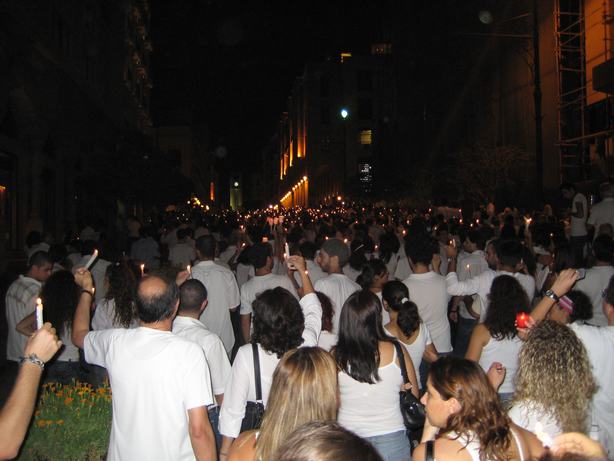
Een autobom voor een politicus raakt nooit alleen het doelwit van de aanslag; lijfwachten en omschuldige omstanders sterven of raken gewond, verliezen ledematen of zijn levenslang getraumatiseerd. Opvallend genoeg is er over het algemeen maar weinig aandacht voor de overledenen die geen politieke waarde hebben – wier leven zelfs na hun dood als inzet wordt gebruikt in het grote politieke spel. Ze zijn allemaal slachtoffers van een publieke moord, maar hun dood wordt alleen in privé-kringen betreurd. Tot de laatste bomaanslag, vorige week, op een relatief onbekend parlementslid. Een jonge man (slechts 363 dagen ouder dan ik), net teruggekomen uit Frankrijk om in Libanon een leven op te bouwen, was op het verkeerde moment op de verkeerde plek en verloor zijn leven door de autobom die parlementslid Antoine Ghanem van het leven beroofde. Zijn naam: Charles Chigani. Deze keer was het de dood van de onschuldige voorbijganger die de meeste aandacht kreeg. Er werden posters geprint met zijn foto, billboards met zijn naam verschenen in Beirut, en gisteravond was er, speciaal voor hem, een ‘stille tocht’ van mensen in het wit die met kaarsen in de hand een stuk door downtown liepen.

De niet-politiek gelieerde organisatie ‘Gallas!’ (Genoeg!) was mede-organisator en greep de gelegenheid aan om de vijandige politieke partijen nogmaals te vragen de strijdbijl te begraven en een einde te maken aan de al zo lang durende politieke crisis. Maar de meeste van mijn vrienden geloofden er niet in, ze waren ervan overtuigd dat ook zijn dood een politiek schaakstuk zou worden, en weigerden mee te lopen in de tocht. ‘Zijn familie is Falangist (rechts-fanatiek-Christelijk) en je zult zien dat ze de aantallen gaan gebruiken als bewijs van steun aan hun partij’. Zelfs al sterf je een zinloze dood, dan zullen we er achteraf wel politieke betekenis aan geven.
Miss-call me

Press-agency Reuters classified it as an ‘Oddly Enough’ news story: the phenomenon of calling someone and hanging up before the call has been answered, in order to save on phone-credit or units (belminuten). It is a practice widespread in Africa, from ‘Cape Town to Cairo’ according to Reuters, and, I would say, further up north – all the way to Lebanon. In Lebanon, ‘miss-calling’ is a verb. A miss-call can literally mean anything, its message depends entirely on what is common among friends, or what is previously agreed verbally or by sms:

‘I will miss-call you when I leave the house.’ ‘Miss-call me when you’re done with work so I can pick you up.’ ‘I will miss-call you when I am 2 blocks away from your house, so be ready to come down because I can’t park in your street.’ “I miss-called you, why didn’t you call me back?”

Calling and hanging up before you before you’ve even had a chance to say hello (the trick is to not establish a connection) is not because Lebanese people don’t like talking. They do. They just don’t like to pay for it, and especially not the exorbitant amounts of money that the local phone-companies charge. If you have a cellphone, you have two options: MTC touch or Alfa. There is hardly any difference between the two, other than that one of the companies is owned by the brother of the minister of telecommunications, and the other is not. They both cost the owner of the phone-number about $50 per month, which let’s you send ±180 messages OR let’s you make 22 calls of 2 minutes. Not a very good deal. Hence the miss-calling.

As the Reuters’ article says: there are certain unwritten rules to follow when miss-calling. It is accepted to miss-call your friends of a similar social class only when you know they are at home and their parents pay the bill of the landline. Otherwise, don’t miss-call your friends and expect them to call you back – unless they are seriously rich, in which case you can leave it up to them: some of my better-off friends who know I don’t have a job right now will not pick up the phone when I call them, but will call me back a minute later, pretending they were busy. Other than that, It’s not ok to miss-call someone you want to ask for a favor – but it is fine to miss-call the pizza place and have them call you back to take your order.

All in all, one has to admit miss-calling is quite an effective method of (tele)communication. Consider the following sms:

‘Want to go see a movie tonight? Pick you up at 8pm. 1 missed-call = yes, 2 missed-calls = no.’

One unit spent, and the evening is arranged.

You know things are going wrong...

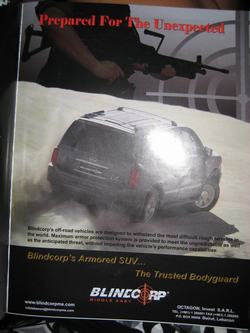
Armored car … when you find this advertisement in a magazine called ‘Lebanon Opportunities’. “Blindcorp’s offroad vehicles are designed to withstand the most difficult rough terrains in the world. Maximum armor protection system is provided to meet the unpredictable as well as the anticipated threat, without impeding the vehicle’s performance capabilities.

Blindcorp’s Armored SUV… The Trusted Bodyguard.”

Even though Blindcorp’s vehicles probably won’t protect you from the ‘anticipated’ threat of car-bombs (favorite way of assassinating people here), the advertisement is clear in its assessment of the needs of the Lebanese market. “… it was only recently that Elie Soueidan (…) decided to branch out into armored car business. Defending a passenger from bullets is, after all, a very different exercise from leasing luxury vehicles. But clients kept asking for the service …”

Other countries Blindcorp serves? “Iraq, Afghanistan, and African countries.” Also: Columbia and Venezuela, amongst others.

And what do you know? Sietske recently found a similar ad.

Mannetjes (het busstation in Syrië)

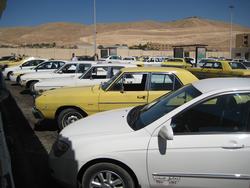
Busstation in DamascusMannetjes op het busstation Het Midden Oosten is niet echt een populaire vakantiebestemming dit jaar. Dubai mag dan hot zijn, verder is het meer angstaanjagend dan exotisch met oorlog in Irak, boze aanvalspraat richting Iran, bomaanslagen in Pakistan, bezetting en verzet in Palestina/Israel en dreiging van burgeroorlog (of civil strife – ‘burgerlijke onrust’ zoals ze het hier optimistisch noemen) in Libanon. Op de dappersten (of domsten) na, zijn er dus maar weinig toeristen te bekennen.

Zo ook in Syrië. In het land zelf gebeurt misschien niet zoveel*, maar een reputatie als epicenter van de ‘As van het Kwaad’ is bepaald niet bevorderlijk voor de reizigersstroom. Vandaar dat ik me vanmorgen twee uur lang op het busstation van Damascus moest vermaken tot de taxichauffeur de vereiste 4 medepassagiers had gevonden en we naar Beirut konden racen. Gelukkig is er op een busstation in Syrië altijd wel wat te beleven.

Elke auto die het terrein van de wachtende taxis oprijdt wordt belaagd door zeker 10 hoopvolle taxichauffeurs. ‘Amman?’ ‘Beirut?’ ‘Saida?’ ‘Shtoura?’ Als de beduusde passagier zijn of haar bestemming heeft genoemd, begint het grote gevecht om de bagage. Hoewel er een semi-officiële volgorde is waarin de auto’s opvullen en vertrekken, zijn er toch altijd slimmerds die er met de bagage vandoor gaan en op die manier de passagier proberen te dwingen met hun auto mee te rijden. De chauffeur die als eerste aan de beurt is pikt dat natuurlijk niet, rent erachter aan, ontfutselt de passagier’s reisdocument en krijgt derhalve zijn rechtmatige reiziger onder zijn hoede. De hele meute rondhangende mannen die op het opstootje afkomen als vliegen op stroop voorzien de weerloze reiziger luidruchtig van advies en maken zo de chaos compleet.

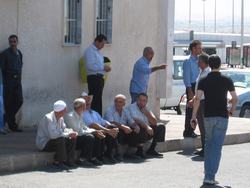
Er zijn maar weinig vrouwen op het busstation. Er zijn taxichauffeurs, politieagenten, mannetjes die tafelkleedjes en tweedehands schoenen verkopen, mannetjes die de volgorde van de wachtende wagens in de gaten houden (meestal met een stok in de hand om opstandige chauffeurs op de vingers te tikken), overheidsbeambten die de uitrij-belasting registreren en innen, en mannetjes die niks anders te doen hebben dan overal commentaar op leveren. Erg zachtzinnig gaat het er niet aan toe – een vriendschappelijke schouderklop gaat niet zelden over in een schreeuwpartij die soms tot luid gelach, en soms tot rake klappen leidt.

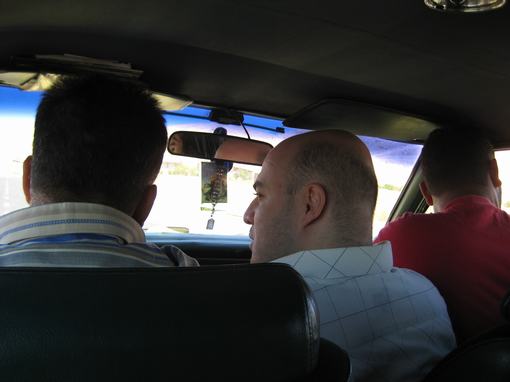
Als de zaken slecht gaan betekent dat weliswaar lange wachttijden op het station, maar de wanhoop van de chauffeur maakt ook dat hij graag je verzoek inwilligt als dat hem een extra passagier oplevert. Zo kwam het dat de vader van mijn mede-reizigster zijn dochter alleen met ons mee wilde stuurde als ze tussen de twee andere dames op de achterbank zou komen te zitten. Nu is het hier gebruikelijk dat de mannelijke passagiers (met z’n tweeën!) op de voorstoel zitten en de vrouwelijke op de achterbank, maar als de mannen in kwestie ieder zo’n 90 kilo lijken te wegen, wordt er wat geschoven in de bezetting zodat de chauffeur in elk geval ruimte heeft zijn stuur te draaien. Niet in dit geval. De vader bleef naast de auto staan tot hij zeker wist dat zijn dochter veilig midden op de achterbank zat. En zo kwam het dat wij alle ruimte hadden, en de mannen voorin met hun zweterige armen strak tegen elkaar aan zaten te schurken.

Mannetjes in de taxi

*(behalve een Israelische aanval op een ‘nucleaire installatie’, naar verluid gebouwd met hulp van Noord Korea, in het noordoosten van het land.)

On a Su-Shi Diet

“You are fasting? Ah, for the day. No? For the whole month? Why would you do that? Next thing we know we will see you wearing a veil!” Yes, I am fasting during the whole month of Ramadan. No, I am not becoming Muslim. I am merely practicing what Anthropologists like to call participant observation. You do what the people around you do, to experience what they experience and thus, hopefully, come to a better understanding of why people think what they think and do what they do. As many people around me are fasting, I decided to join them and not eat and drink from sunrise to sunset for one whole month (in Lebanon, this is from around 4.45am until 7pm – apparently, in The Netherlands sunset isn’t until 8.30pm… pfff!).

The first day was a big shock. I had decided to wake up at 4.30am to drink enough water for the whole day. Big mistake: as I laid back down, my belly was playing storm-on-sea and there was no way I would sleep again. At noon, my brain started to fade, and at 6pm I had trouble looking straight. Dinner, at my beloved’s parents’ place, was a relief. The opening bite was the traditional date followed by a sweet drink, and then the equally traditional lentil-soup and fattoush (a Lebanese salad) which went down faster than a fish down a waterfall. Glasses and glasses of water to quench the thirst, regretted half an hour later as I sat on the couch to digest, feeling I was about to explode.

Fasting has become less hard over the days. The hour at which the fatigue sets in gradually moves to later in the afternoon, and I occasionally manage to think about something else than food or drinking. The good part are the iftars – the dinner to break the fast after sunset. Here goes: the more the merrier, and eating alone during Ramadan is not done, so I am, like last year, invited to many a home-cooked meal. But I don’t mind eating my iftar alone. There is a certain magic to preparing the meal without so much as licking my fingers to taste what I am cooking, setting the table on the balcony, and then, with so many people on the balconies around me, waiting for the mosque to start singing; the sign that dinner can be consumed. The only problem is which mosque to follow: Sunnis start eating when the mosque is done singing, but Shia generally wait another 20 minutes or so, just to be sure that the sun has gone down completely.

On the balconies across the street I see two families – one on the 5th, one on the 2nd floor. The grandfather on the 5th floor usually sits down at the table long before sunset, and he is joined quickly by his family members as the call to prayer ends. Silence, interspersed by the clicking knifes and forks on the plates, ensues. I am guessing they are Sunni. It takes another quarter of an hour for the grandmother to emerge on the 2nd floor, with a big bowl of soup in her hands. Their dedication to fast until the last moment implies they are Shia. Me? I have started eating somewhere in between the two. I am on a Su-Shi diet.