Qussa

Stories from Afar & Up Close

+970

So now we can call to Palestine. Until yesterday, if you wanted to talk to someone in the Occupied Territories, you’d have to call from Lebanon to Jordan, and Jordan would connect you to Gaza, Ramallah or the West Bank. It was the first decision of the new minister of telecommunications of the brand new Lebanese government, to open the lines with some of our Southern neighbors. We still can’t make phone-calls to Israel, though. But Israel can call us. They did, during the war of July 2006, to tell us that we were playing with fire by allowing Hassan Nasrallah to ‘play around in our country’, and that we would burn for it. Not that we didn’t notice already. Apparently they are still doing the telephonic anti-propaganda, because a few days ago Walid’s grandfather picked up the receiver and heard a voice explaining to him in perfect Arabic that really, it’s time to get rid of Hezbollah. The old man, not knowing it was a recording on the other end of the line, gave them a piece of his mind: he would decide who to support and who not.

So what if we could call Israel? Would anyone there listen to political advice from this side of the border?

Een niet-Sji'iet

Twee jaar geleden maakte een Nederlandse journaliste een kort filmpje over het uitgaansleven van Beirut tijdens de oorlog met Israel, waarin Faysal, een vriend van mij, geïnterviewd werd. Door het betere knip- en plakwerk tijdens de montage kwam zijn introductie ongeveer over als: “Ik ben Faysal. Ik ben een Sji’ietische moslim. Ik ga elke avond uit en drink alcohol.” De reacties op het filmpje (te zien op de website van het tv-station dat het had uitgezonden) waren voorspelbaar: “Nou, dat is echt geen moslim. Moslims drinken geen alcohol.”

Klopt. Faysal vindt zichzelf geen moslim. Maar geen religie hebben bestaat niet in Libanon. Bij je geboorte krijg je automatisch de religie van je vader (of die nou ergens in gelooft of niet – hij heeft ‘m weer van zijn vader gekregen), en dat bepaalt vervolgens een heel aantal zaken in je leven: huwelijk, scheiding, erfrecht, het zijn allemaal dingen die in het burgerlijk wetboek niet voorkomen, en die uitsluitend en alleen volgens de ‘wetten’ van je religie geregeld worden. (Zo kunnen Christelijke Maronieten bijvoorbeeld niet scheiden, en krijgen Sunnietische grootouders aan vaderszijde de voogdij over kleinkinderen ouder dan 7 jaar als de vader overlijdt). Je religie zegt niets over je religiositeit, en alles over welke posities je kunt bereiken in de overheid (alleen Maronieten kunnen President en Opperbevelhebber van het leger worden, alleen Sji’ieten kunnen Voorzitter van het Parlement worden, etc.). Gelovig of niet, op je ID-kaart staat een religie vermeld, en aanmeldinsformulieren op scholen en universiteiten hebben zonder uitzondering een vakje voor je godsdienst – een vakje dat je verplicht bent in te vullen.

Faysal zegt dus “Ik ben Sji’iet,” zonder dat hij zich de morele voorschriften van de Islam houdt, en iedereen in Libanon begrijpt dat dat kan. Het gelijkstellen van geloof en gelovigheid, zoals de Nederlander die commentaar leverde op het filmpje deed, gebeurt hier niet – en wordt ook niet begrepen. Atheist? Agnost? Helemaal niets? Dat komt simpelweg niet voor.

Welke feestdagen vier jij eigenlijk? Vroeg mijn collega een paar dagen geleden, vissend naar mijn religie. Dit jaar heb ik kerstmis gevierd, en ik heb gevast voor Ramadan, was mijn antwoord. Oh, ben je geen Christen dan? Vroeg ze door. Nee, ik ben geen Christen. Wat ik dan wel was, wilde ze weten. Mijn Niets. Ik ben helemaal niets, werd ontvangen met een heftig hoofdschudden.

Nee, nee. Je begrijpt het niet. Ik vraag wat je bent, wat is je familie? Walid moest hartelijk lachen toen ik de conversatie navertelde. Zelfs na drie jaar in Nederland is het voor hem nog moeilijk zich voor te stellen dat je je niet automatisch met een religie identificeert, omdat je die nou eenmaal bij je geboorte is toegeschreven. Als je in Libanon niet gelooft, dan betekent dat niet dat je ‘niets’ bent – dan betekent dat dat je niet-iets bent.

Dus in Libanon ben ik een niet-Protestant. En Faysal is een niet-Sji’iet.

Hup Holland Hup

At the time of writing, it’s 2 for the Dutch team and 0 for the Italians. I still don’t really understand the excitement that football generates in this country, seeing that the only sport worth a national team is basketball, but tonight there truly is something at stake. No, I don’t say that because it’s my own national team playing. It’s because of their opponent. Look at this… 1968 Italy wins European Championship. and 1968 ‘Operation Gift’: Israel Defense Forces (IDF) commando raid on Beirut International Airport.

1982 Italy wins the World Cup. and 1982 ‘Operation Peace of Galilee’ / First Lebanon War: Israeli invasion of Lebanon, up to and including Beirut, resulting in the occupation of South Lebanon (liberated in 2000).

2006 Italy wins the World Cup. and 2006 ‘Second Lebanon War’. Israel attempts to invade Lebanon, bombs large parts of South Lebanon, Southern Suburbs of Beirut and Bekaa.

See the pattern? It’s mainly for safety reasons that I want the Dutch team to win…

Pure logic

Traffic in Lebanon is chaotic, to put it mildly. Major crossroads in Beirut are puzzles of honking cars, inching around each other, blocking everyone's way, trying to get to the other end in complete disregard of all the other traffic. Sometimes, there is a policeman trying to bring some order to the chaos, but more often than not the assigned officer gives up after half an hour of being completely ignored, yelled at and (almost) driven over. I don't blame the poor guys - getting Lebanese people in cars to follow a certain structure, the personal benefit of which is not immediately clear, is an impossible task indeed. But what do I know? Today my service-driver swirved his way around garbage-bins, passed two cars on the right and then threw his steering wheel all the way to the left to switch lanes and get across the intersection. One of the passengers pointed at the policeman who was frantically waving his stick to get people to follow his directions. 'Uh huh,' said the driver, 'if I do what he says, I will never get across!' 'Yeah,' added the other passenger with an accusing nod of the head towards the officer, 'have you noticed? There's always a traffic-jam when there is a policeman trying to arrange traffic!'

I guess it's the Lebanese version of the chicken-and-egg conundrum.

Inbox Lebanon

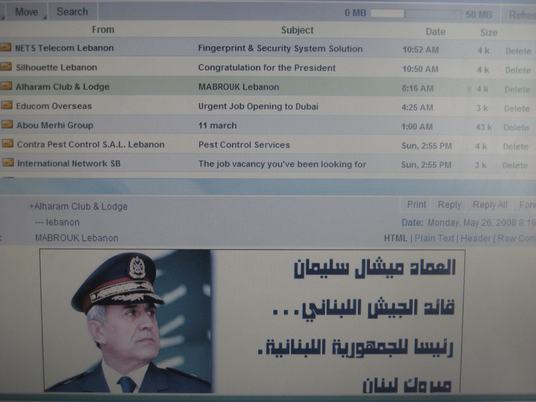
Inbox met Generaal/President It is with pleasure and anticipation that I open my email-inbox at work every morning. Not because of the amount of interesting letters, but because of the advertisements. The spam messages for blue pills and other body-part enhancing potions that I find in my private mail are useless compared to the advertisements I receive at the work-address. The offers for explosion-proof cars, announcements about vacancies in Saudi Arabia, and messages urging me to join the gym to look good for summer – they are a perfect way to keep up with the situation in the country without having to read the newspaper or watch the news on TV. Unrest and economic malaise? Increase in job-offers in the Gulf. Explosions and car-bombs? Increase in gadgets to detect explosives before they set off. Violence in the streets? Increase in options to shatter-proof your windows. Agreement reached in Doha? Book your table now at your favorite restaurant – and don’t forget the option of plastic surgery before bikini-season.

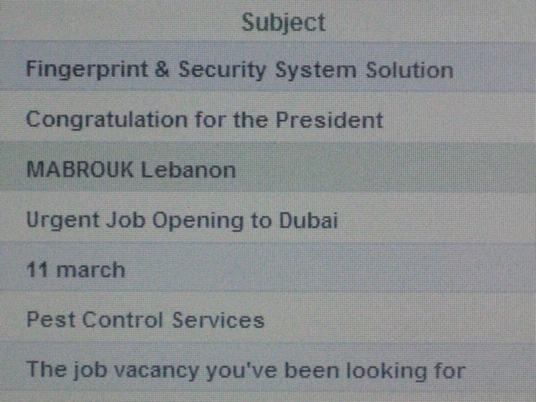
So are you curious to know how Lebanon is doing these days? Just take a peek at my inbox of this morning:

Inbox zoom in