
Qussa

Stories from Afar & Up Close

The Unfair Lightness of Being

So Lebanon has a problem with electricity. Not only are the electric cords so old and rotten that with every bit of rain they break and leave whole neighborhoods in the dark, and not only is illegally tapping public power sources (streetlights and such) and refusal to pay the electricity bills a common occurrence, there also simply isn’t enough electricity. What does that mean, you ask? It means that every day, for a few hours, the electricity goes off. These power-cuts are scheduled on different hours during the week. For example, on Monday, the power cuts from 3 in the afternoon until 6 in the evening. Tuesday, it cuts from noon to 3pm. Wednesday, there is no electricity from 9am until noon, and Thursday from 6am to 9am. On Friday, the cycle starts over again at 3pm. And this is for the lucky ones in Beirut – outside of the capital, the power-cuts can go up to six, seven, eight, in some places even 10 hours a day.

In many places, people buy private generators or subscribe to a big one that provides for the whole neighborhood. Some buildings have a generator just for the elevators, but ours unfortunately doesn’t. Not that I mind a bit of physical exercise, but I do plan my grocery-shopping around the power-cut – I don’t feel the need to carry the 10-liter bottles of potable water all the way up to the 8th floor. And it’s not only the grocery shopping that gets scheduled during electricity hours; the same goes for showers (no hot water!), watching a movie (no TV / computer!) and even cleaning the house (no music!). Luxury problems, true, but inconvenient nonetheless – and I have come to realize it contributes greatly to the feeling of ‘in Lebanon, you can never decide for yourself, it’s always outside forces that determine your life’ that I have heard so many Lebanese people express over the time. It’s not just about wars and major political events; it’s the small, daily stuff that puts you out of control over your own actions.

But back to the electricity, and there not being enough of it. As I said, those of us living in Beirut are lucky, with the minimal power-cut of three hours, thanks to the strange reasoning that ‘tourists come to Beirut so the businesses there need it more than elsewhere’. With the arrival of a new minister for electric affairs, however, this unfairness was going to be addressed: cutting the electricity in Beirut for four hours a day instead of three would presumably free up enough electricity to bring back the power-cuts everywhere else in the country to five or six hours. All fair and well, right? But no, heavy protest ensued, especially from those men in the government with many followers in the city. It was even named an attack on the capital, and a continuation of the siege that happened in May. So the fair and equal distribution of electricity throughout the country never happened, and Beirut is still given preferential treatment with 21 hours of electricity a day.
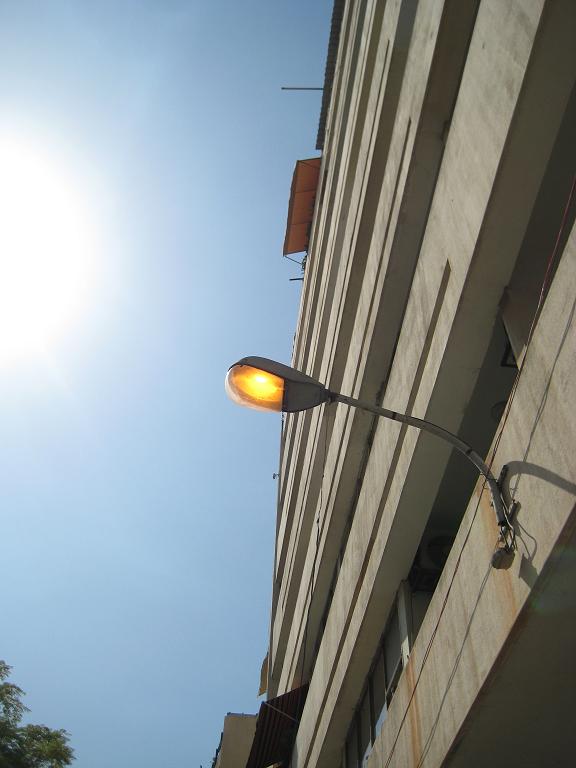
Bragging about electricity

Obviously, I don’t mind, living in a house on the 8th floor with no generator. But I don’t think we need to brag about it by leaving the streetlights on even during the day…

Bits and Pieces

I am the 804,100,258th richest person on earth!Remember when I told you that one quarter of the people in Lebanon live under the absolute poverty line? Well, even when living on a salary that is modest according to Lebanese standards for someone with my level of education, I am still in the top 13,4% of richest people in the world. Do you want to know how rich you really are? You can calculate it here in (literally) 1 second.

I’m famous! Eh, well, in the Netherlands at least. And only among those who have been listening to BNN Radio / BNN Today and have paid attention to the 3-minute segment called ‘Exit Holland’. As someone who has left the low country, I have been asked to shine some light on the rare and the mundane stuff of life in Lebanon. If you go here, you can hear what I had to say about the falafel-war between Israel and Lebanon (in Dutch only, unfortunately). (Als je klikt op Uitzending van 21 Oktober, en je vindt daar mijn naam, dan kun je ook eerdere uitzendingen beluisteren.) I have a new blog! No, I’m not leaving this one. There will be plenty of stories to follow. But the other one is for pictures, you see. That’s why I called it Qussa : The Visuals. One photo a day, to illustrate what’s being said here, or for something completely different – whatever I feel like showing you. So come over here and have a look!

Help! De Dokter Schrijft Voor

Elk land kent zo zijn eigen gewoontes en gebruiken als het gaat om de behandeling van veel-voorkomende ziektes en mankementen. In Libanon roept men direct ‘vitamine C!’ bij een niesbui, serveert men 7 up bij maag- en darmklachten, en is panadol de aanrader voor zo ongeveer alle andere kwalen. Mochten bovenstaande middelen onverhoopt niet het juiste effect bereiken, dan is een bezoekje aan de dokter zo gemaakt. (De ratio dokters : inwoners is in Libanon zó hoog, dat velen van hen achter de apothekersbalie staan en de medicijnen op recept direct aan je meegeven.) De eerste keer dat ik hier in Beirut naar de dokter ging was in de zomer van 2006. Ik had een vreemde plek onder mijn arm en toen die na anderhalve week maar niet weg bleek te gaan, ging ik ermee langs bij de ‘familie-arts’ in het ziekenhuis van de Amerikaanse Universiteit van Beirut. De arts was verbaasd dat ik er zolang mee had rondgelopen. ‘Is het iets ernstigs?’ vroeg ik hem enigzins geschrokken. Nee, dat was het absoluut niet, maar voor de zekerheid kreeg ik toch maar een antibiotica-kuur voorgeschreven. Op mijn vraag of dat wel echt nodig was, lachte hij hartelijk en zei me dat ik ook wel wat kruiden mocht plukken uit zijn tuin om een magisch drankje mee te koken… Het ging erom dat het zo sneller wegging – zo zou het geen week, maar slechts 4 dagen duren! Hoewel niet geheel overtuigd van het nut van de door hem voorgeschreven medicijnen, heb ik de pillen braaf tot het einde van de kuur geslikt.

Walid, toen hij nog in Nederland woonde, had er een hekel aan om naar de huisarts te gaan als hem iets mankeerde. ‘Ze zeggen toch altijd “kijk het nog maar een paar dagen aan”!’ klaagde hij dan. Een eveneens in Amsterdam woonachtige Israelische vriendin was ook al stomverbaasd toen mijn huisarts me antibiotica had voorgeschreven. ‘Mijn huisarts wil geloof ik eerst dat ik op sterven lig, voordat ik ooit een antibiotica-kuur van hem zal krijgen!’ Het verschil met de artsen hier die er lustig op los voorschrijven is inderdaad groot.

Zo groot zelfs dat ik een aantal weken terug aarzelde een doktersbezoek af te leggen, ondanks het feit dat ik een knobbeltje in mijn nek had dat niet van plan leek vanzelf weg te gaan. Ik had er geen last van, het deed geen pijn, maar je weet nooit. Ik besloot uiteindelijk rond te vragen naar een arts die erom bekend staat niet nodeloos naar de medicijnen te verwijzen. Via-via werd er voor mij een afspraak gemaakt. In een klein kamertje op de derde verdieping, behangen met posters vol fotos van nare huidziektes, werd het knobbeltje bestudeerd. Ah, zei de dokter, dat is het gevolg van een instectenbeet. Niks ernstigs, het trekt vanzelf weer weg. Mooi, dacht ik. Hij liet het me zelfs nog zien in een boekje, een oud exemplaar uit de jaren ‘70 waarvan de pagina’s alle kanten op wapperden. ‘Ik zal je wat voorschrijven om de huid schoon te houden. Heb je toevallig nog darmproblemen?’

Ik begreep het verband tussen die laatste twee vragen pas toen ik volledig verbouwereerd op de stoep van de apotheek stond, alle voorgeschreven medicijnen in de hand: anti-muggenspray (2x per dag aanbrengen); desinfectie-zalf (2x per dag opsmeren); antibiotische anti-zwelling-zalf (2x per dag aanbrengen); en een flinke doos pijnstillers for extra pain, (3x per dag innemen, niet voor een zwakke maag).

Eenmaal thuis heb ik het nog maar eens een weekje aangekeken. Knobbeltje? Helemaal verdwenen. Zak met medicijnen? Onaangeroerd in de kast…

Poor Lebanese

It struck me, my first time in Lebanon in 2005, how little poverty I saw. No beggars, no people scouring the garbage, hardly any street-vendors, panhandlers, little kids trying to sell gum or polish shoes. Maybe I was blinded by the bling of the upper class, or maybe it was indeed hardly there. I remember asking my friend about it. After all, she often complained about Lebanon being ‘not even’ a third-world country. Her answer was that Lebanese people were too proud: nobody would let anybody in their family get so poor that they had to display it for the rest of society to see. Bedouins would go around begging, she said, but Lebanese people would always make sure that no one could accuse them of not taking care of even their most remote family-members. But over the course of the past few years, life has not become easier in Lebanon. War, political crisis, and simply being part of a world in which the rich keep getting richer and the poor keep getting poorer – whatever be the cause, the result is increasing suffering for many Lebanese people. Following the definition of the World Bank, an astounding 28.5% of the Lebanese live below the poverty line. That’s about one million people, in a country of around four million.

I now do see beggars. I see people digging in the garbage for cans and bottles, but also for food-items that are still edible. I see more and more children trying to sell roses on busy roads late at night. I see people riding around their (grand)parents in wheelchairs to collect money from passers-by. I see the old woman who knocked on my door, today, after walking 8 flights of stairs, to ask if I have anything for her to clean. I see a van-driver whose minibus breaks down and can only be repaired if he buys the required part, which costs $400 – news which sends him into a screaming panic… crying, completely desperate, the driver hit his front screen so hard it broke. He broke the glass with his bare hands.

Poverty, I think, is one of the most debilitating conditions a person can live in. Real, deep poverty, the one where you have to choose between using the bed-net as a fishnet to be able to eat, or as a mosquito-net not to get malaria. The one where you have to choose between giving your children to eat, or eating the food yourself so you will have enough energy to go out and try to find work. The one that makes you break your windshield in desperation because you know you will never be able to afford the necessary car-part, which means your single source of income (and that of all those who depend on you) just disappeared.

Today is Blog Action Day, and on many, many blogs, people will write about poverty. I hope some of it will translate into small or big actions to finally get everyone up to an acceptable standard of living. If you’d like and you have $25 or more to lend to someone for a while (and get them back later!), join me in micro-financing a loan through Kiva. And if you have another idea to get rid of poverty, I’d love to hear about it in the comments!